

For many international patients, travelling abroad for joint replacement is not just a medical decision; it is a personal one. Patients often want to feel confident that once they leave home, every step of their care is planned, predictable, and safe, from surgery to recovery after returning home.
This is why robotic joint replacement at Apollo Hospital, Delhi, has become a preferred option for international patients seeking safe, precise knee and hip replacement surgery in India. Indraprastha Apollo Hospitals, New Delhi, is among Apollo’s JCI-accredited hospitals and is recognised for its standardised clinical protocols, quality-driven systems, and consistent focus on patient safety.
This guide explains how robotic joint replacement at Apollo Hospital works, its safety advantages, and what international patients can expect throughout treatment and recovery.
What Robotic Joint Replacement Really Means
A common question patients ask is whether the robot “does the surgery by itself.” In reality, robotic joint replacement is entirely surgeon-led.
The robotic system serves as a highly advanced surgical tool, supporting the surgeon’s decision-making and execution.
In robotic joint replacement in Delhi, systems such as MAKO SmartRobotics assist surgeons by providing:
- CT-based, patient-specific 3D planning
- Precise bone preparation based on that plan
- Real-time intra-operative guidance to stay within defined safety boundaries
Before surgery, detailed CT imaging allows the surgeon to study your joint anatomy, deformity, and arthritis pattern.
During surgery, robotic guidance helps the surgeon reproduce the plan with high accuracy. Unlike conventional techniques that rely heavily on visual estimation and manual guidance, robotic assistance aims to reduce variability, a key factor in surgical safety.
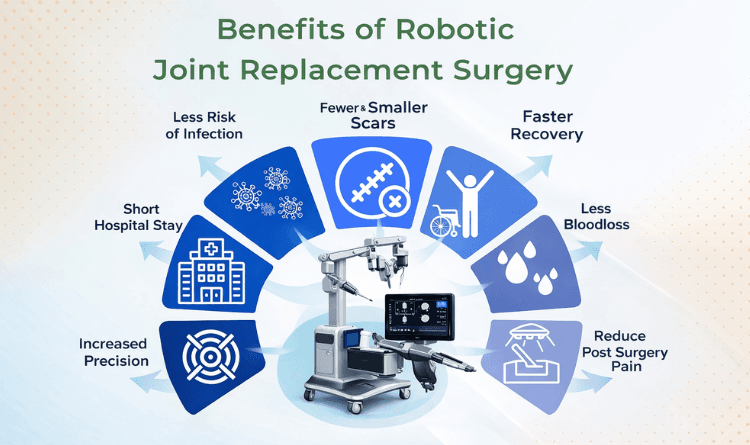
Why Precision Improves Safety in Knee & Hip Replacement
Joint replacement is not just about pain relief; it is about restoring stable, confident movement for years or decades. Outcomes are strongly influenced by small technical factors, including:
- Implant alignment
- Implant positioning
- Ligament balance (especially in knee replacement)
- Leg length and offset (critical in hip replacement)
Even very small inaccuracies can affect how you walk, how stable the joint feels, and how long the implant lasts. Robotic systems are designed to help surgeons execute a well-defined plan consistently, which is especially important for international patients who want:
- A clear surgical plan before committing to travel
- Fewer unexpected intra-operative changes
- A predictable early recovery window, allowing safe air travel once cleared
This emphasis on reproducibility is one of the reasons many patients consider Apollo the best hospital for robotic joint replacement in Delhi.
Robotic Joint Replacement at Apollo Hospital: Step-by-Step Pathway
Although each patient is unique, robotic joint replacement at Apollo generally follows a structured and safety-focused pathway.
1. Pre-Operative Evaluation
For international patients, evaluation may begin remotely or after arrival and usually includes:
- Specialist orthopaedic consultation
- Review of X-rays and CT scans (as indicated)
- Assessment of fitness for anaesthesia
- Discussion of implant options, risks, and realistic outcomes
Sharing medical reports in advance often shortens hospital stay and improves planning accuracy.
2. CT-Based 3D Planning
A key feature of MAKO robotic joint replacement at Apollo Delhi is CT-based 3D planning. This allows surgeons to:
- Select optimal implant size
- Define precise alignment targets
- Plan bone resections customised to your anatomy
Instead of relying on standard averages, the surgical plan is tailored to your joint structure and disease pattern, improving predictability.
3. Robotic Assistance During Surgery
During surgery:
- The surgeon performs every step of the operation
- The robotic arm provides guidance and feedback
- Adjustments can be made in real time if required
Important safety note: Robotic assistance enhances precision but does not replace surgical judgement, infection prevention, or post-operative care protocols.
Robotic Knee Replacement at Apollo Hospital, Delhi: Safety Benefits Patients Value
Patients considering robotic knee replacement at Apollo Hospital, Delhi often focus on:
- Knee stability and natural movement
- Smooth, complication-free recovery
Robotic assistance is commonly used to optimise alignment and ligament balancing, which can support better knee mechanics when combined with structured physiotherapy.
Overall safety also depends on:
- Strict infection-control measures
- Blood-clot prevention protocols
- Multimodal pain management
- Early mobilisation and supervised rehabilitation
For international patients, having a clear walking and physiotherapy plan before discharge is essential for safe recovery back home.
Robotic Hip Replacement at Apollo Hospital: Predictability for International Travellers
Patients travelling for robotic hip replacement at Apollo Hospital often worry about:
- Leg-length difference
- Stability and dislocation risk
- Ability to walk, climb stairs, and sit comfortably before flying
Robotic planning supports accurate implant positioning and alignment. However, hip replacement safety also depends on:
- Bone quality
- Underlying diagnosis (arthritis, avascular necrosis, post-traumatic arthritis)
- Adherence to early movement precautions
Robotic assistance is therefore recommended selectively, when it adds clear value to patient safety and outcomes.
Hospital-Level Safety at Apollo: Why Systems Matter as Much as Technology
For international medical tourists, true safety extends beyond surgical technique. At Indraprastha Apollo Hospitals, safety systems typically include:
- Structured pre-anaesthesia evaluation
- Standardised infection-prevention protocols
- Fully equipped operating theatres
- ICU backup and blood-bank support
- Surgical safety checklists and post-op monitoring pathways
These systems ensure preparedness not only for routine recovery, but also for unexpected medical situations—an important consideration when patients are far from home.
The Multidisciplinary Team Supporting Safer Outcomes
Successful robotic joint replacement is a team effort, involving:
- Anaesthesiologists (pain control and mobilisation safety)
- Physiotherapists (gait training, stairs, strengthening)
- Nursing teams (wound care and infection prevention)
- Medical specialists managing diabetes, blood pressure, or cardiac risk
This multidisciplinary approach ensures continuity of care from surgery through rehabilitation.
What International Patients Can Expect: A Safety-Focused Medical Travel Journey
Before Travel
- Share recent imaging and medical records
- Provide a complete medication list
- Discuss expected length of stay and recovery milestones
After Arrival
- In-person assessment and confirmation of the surgical plan
- Pre-anaesthesia clearance (blood tests, ECG, chest evaluation as needed)
- Discussion of risks, benefits, and recovery expectations
Discharge and Aftercare
- Written wound-care and medication instructions
- Blood-clot prevention plan
- Physiotherapy roadmap for home-country continuation
- Clear red-flag symptoms and follow-up plan (including teleconsultation if appropriate)
A predictable early recovery window is essential for patients planning return flights within a fixed timeframe.
Who Is an Ideal Candidate for Robotic-Assisted Joint Replacement?
Robotic-assisted surgery may be particularly useful for patients with:
- Complex joint anatomy or deformity
- Need for highly precise alignment
- High expectations for reproducibility and accuracy
It may not be suitable if:
- There is an active infection
- Medical conditions are poorly controlled
- Bone quality significantly limits fixation (case-dependent)
The safest decision is always individualised, based on imaging, diagnosis, and overall health.
The Bottom Line
For international medical tourists, safety in joint replacement depends on clear planning, surgical precision, robust hospital systems, and structured aftercare.
Robotic joint replacement at Apollo Hospital, Delhi is often considered because it combines robotic-assisted planning and execution (including MAKO technology) with internationally recognised quality standards and a multidisciplinary recovery pathway designed to support safe surgery and continuity of care even after patients return home.



 Chat
Chat