

Thyroid cancer treatment in Germany usually starts with surgery. Depending on the cancer type and the risk of it coming back, surgery may be followed by radioactive iodine (RAI) therapy and thyroid hormone medication. Patients with advanced disease may also receive targeted drugs or external radiation.
Most thyroid cancers are highly treatable. For papillary thyroid cancer, the most common type, the 5-year relative survival rate is above 99% when the cancer is confined to the thyroid.
International patients often consider Germany because care is organised around specialist teams and national standards. In 2025, Germany's oncology guideline programme published its first S3 guideline for thyroid cancer, aiming to make diagnosis and treatment more consistent across the country. S3 is the highest evidence level for German guidelines.
This guide explains:
what treatment may involve
how the German system works for overseas patients
what drives cost
how to choose a hospital
how to prepare before you travel
What Is Thyroid Cancer?
Thyroid cancer begins in the thyroid gland, a small butterfly-shaped gland located at the base of the neck. This gland produces hormones that regulate metabolism, heart rate, body temperature, and energy levels. When abnormal cells grow uncontrollably, they can form a tumour that may require specialised treatment.
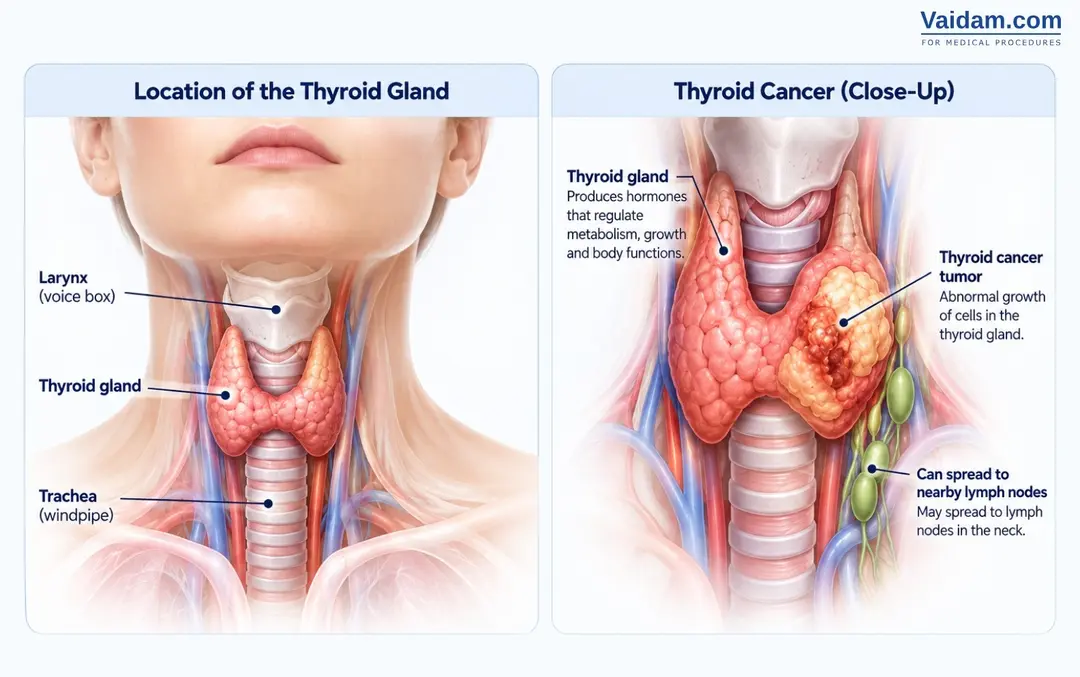
The type of thyroid cancer affects treatment more than almost anything else. Doctors group the types by the cell the cancer starts in.
Type | Starts in | What it means for treatment |
Papillary | Follicular cells | The most common type. Usually slow-growing and often absorbs iodine, so RAI can be used when needed. |
Follicular | Follicular cells | Can spread through the bloodstream to lungs or bones. Also usually iodine-absorbing. |
Oncocytic (formerly Hürthle cell) | Follicular cells | Now assessed separately from papillary cancer in current risk systems. Absorbs iodine less reliably. |
Medullary | C cells (make calcitonin) | Does not absorb iodine, so RAI is not used. Some cases are inherited through a change in the RET gene. |
Anaplastic | Follicular cells (undifferentiated) | Rare and fast-growing. Needs urgent specialist assessment and molecular testing. |
Papillary, follicular and oncocytic cancers are grouped as differentiated thyroid cancer (DTC). Differentiated thyroid cancer is the most common form and includes these three subtypes. Medullary thyroid cancer is a rarer form that can run in families.
Symptoms and When to Seek Assessment
Many thyroid cancers cause no symptoms. They are often found by chance on an ultrasound or scan done for another reason.
When symptoms do occur, they may include:
a lump or swelling in the front of the neck
swollen lymph nodes in the neck
hoarseness or a change in voice that does not settle
difficulty swallowing or a feeling of pressure in the throat
breathing difficulty, usually only with larger or fast-growing tumours
Most thyroid lumps are benign. Any new lump or persistent voice change should still be checked by a doctor. Rapid neck swelling with breathing difficulty needs urgent care before any travel is considered.
How Thyroid Cancer Is Diagnosed?
If you already have a diagnosis, a German team will review your existing results first. They may repeat or add tests to confirm the type and extent of the cancer before recommending treatment.
Neck ultrasound. This is the main imaging test for thyroid nodules and neck lymph nodes. Under the German S3 guideline, the malignancy risk of a nodule should be assessed with a TIRADS classification system. TIRADS (Thyroid Imaging Reporting and Data System) scores ultrasound features to judge how suspicious a nodule looks.
Fine-needle aspiration (FNA) biopsy. A thin needle, guided by ultrasound, draws cells from the nodule or a lymph node. A cytopathologist then examines the cells.
Blood tests.
Thyroid function tests, including TSH (thyroid-stimulating hormone).
Calcitonin and CEA (carcinoembryonic antigen) when medullary cancer is suspected.
Thyroglobulin, which is used mainly after treatment as a tumour marker.
Molecular testing. Tumour tissue may be tested for gene changes such as BRAF, RET or NTRK. The results can refine the diagnosis and show whether a targeted drug may be an option later.
Genetic counselling. For medullary cancer, blood testing for an inherited RET change matters. It can affect relatives, who may need testing too.
Further imaging. CT, MRI, PET/CT or radioiodine scans are used when doctors need to check for spread or recurrence.
Tumour board review. The German guideline recommends presenting suspected thyroid cancer to an interdisciplinary tumour board, where the approach is discussed and recommended on a case-by-case basis. A tumour board is a meeting of surgeons, endocrinologists, nuclear medicine specialists, pathologists and oncologists.
Staging and Risk Assessment
Two systems are used together.
TNM staging (AJCC 8th edition) describes:
tumour size and local spread (T)
lymph node involvement (N)
distant spread (M)
For papillary and follicular cancer, age matters. Stage IVA and IVB papillary or follicular thyroid cancer apply only to patients aged 55 or older. Younger patients with these types are staged as I or II, even when lymph nodes are involved.
Recurrence-risk assessment estimates the chance of the cancer coming back. This is what guides decisions about the extent of surgery and whether RAI is needed. The 2025 American Thyroid Association (ATA) guideline assesses follicular and oncocytic cancers separately from papillary cancer. It also uses four risk categories: low, low-intermediate, intermediate-high and high.
Thyroid Cancer Treatment Options
Treatment is chosen according to:
cancer type
tumour size
spread to lymph nodes or beyond
recurrence risk
age and overall health
your own preferences after discussion with the team
Not every patient needs every treatment. Many people with low-risk cancer need surgery and follow-up only.
Surgery
Surgery is the main treatment for most thyroid cancers. The options are:
Lobectomy (hemithyroidectomy). Removes one lobe of the thyroid. Some patients keep enough thyroid function that they do not need daily hormone tablets.
Total thyroidectomy. Removes the whole gland. Lifelong thyroid hormone replacement is then needed.
Neck dissection. Removes lymph nodes in the central or side compartments of the neck when cancer has spread there, or when the risk is high.
Current guidance recommends less extensive surgery for selected small, low-risk cancers than older guidance did.
ATA 2025:
Cancer ≤2 cm confined to one lobe, with no extension outside the thyroid and no lymph node spread: lobectomy.
Similar cancers between 2 and 4 cm: lobectomy or total thyroidectomy, depending on tumour features, nodules in the other lobe and patient preference.
German S3 guideline (slightly more cautious):
Total thyroidectomy remains the standard for papillary cancers over 1 cm. It is also explicitly recommended for multifocal cancers, familial papillary cancer and aggressive histological variants.
Hemithyroidectomy may be considered in justified cases without risk factors for pT1b/pT2 tumours. The guideline notes that study findings on survival and recurrence differ.
In practice, a German surgeon may recommend total thyroidectomy where a US centre would offer lobectomy, or the reverse. It is a reasonable topic to discuss in your consultation.
Surgical risks. The specific risks of thyroid cancer surgery are recurrent laryngeal nerve injury, which can cause hoarseness and swallowing difficulty, and hypoparathyroidism, which lowers blood calcium. Surgical risks are lower with lobectomy than with total thyroidectomy.
The recurrent laryngeal nerve controls the vocal cords.
The parathyroid glands sit next to the thyroid and control calcium levels.
Most voice and calcium changes after surgery are temporary. Ask how often permanent problems occur in the team's own practice.
Radioactive Iodine (RAI) Therapy
RAI uses iodine-131, taken as a capsule or liquid. Because thyroid cells absorb iodine, the radiation targets remaining thyroid tissue and iodine-absorbing cancer cells. RAI is used only for differentiated thyroid cancer, not for medullary or most anaplastic cancers.
RAI is no longer routine for everyone. The German S3 guideline has a dedicated chapter on when RAI is useful and when it offers no benefit. The decision depends mainly on recurrence risk and the pathology results after surgery.
Preparation. Thyroid cells must be stimulated by a high TSH level before RAI. This can be done in two ways:
temporarily stopping thyroid hormone tablets for several weeks, or
recombinant human TSH (rhTSH) injections, which avoid a period of hypothyroid symptoms
A low-iodine diet is also needed in the weeks before treatment. Iodine-containing CT contrast should be avoided.
Why this matters if you are travelling. The preparation method affects how long you need to plan for, and how well you will feel while travelling.
Inpatient stay in Germany. German law requires radioiodine therapy to be given on an inpatient basis. The stay depends on how quickly radioactivity leaves the body, and most patients are discharged from the nuclear medicine ward in under four days. Before you fly home, your team will explain precautions around close contact with others, especially children and pregnant women.
Possible side effects:
temporary neck tenderness
nausea
changes in taste
salivary gland swelling or dry mouth
The risk of side effects such as dry mouth rises particularly with high or repeated RAI doses.
Fertility and pregnancy. Pregnancy must be excluded before RAI. Pregnancy should be avoided for a period afterwards, and your team will specify how long.
Thyroid Hormone Therapy
After total thyroidectomy, daily levothyroxine replaces the hormone the thyroid used to make. After lobectomy, some patients need it, and some do not, depending on how well the remaining lobe works.
For higher-risk patients, doctors may aim for a slightly lower TSH to reduce stimulation of any remaining cancer cells. This is called TSH suppression. It is balanced against effects on the heart and bones, and the target is usually relaxed over time if follow-up results are reassuring.
External Beam Radiation Therapy
External radiation is not part of standard treatment for most thyroid cancers. It may be considered when:
cancer cannot be fully removed
it has grown into structures such as the trachea or oesophagus
disease no longer absorbs iodine
symptoms from bone metastases need controlling
It is also part of treatment for many anaplastic cancers.
Targeted Therapy
Targeted drugs, mostly tablets called kinase inhibitors, are used for advanced, progressive disease that cannot be cured with surgery or RAI. The drug is chosen according to the cancer type and any gene change found in the tumour.
RAI-refractory differentiated cancer (cancer that no longer responds to RAI): sorafenib and lenvatinib are licensed by both the FDA and EMA for progressive, locally advanced or metastatic differentiated thyroid cancer that no longer responds to iodine-131.
Medullary cancer: vandetanib and cabozantinib are approved for metastatic, progressive medullary cancer.
RET-altered cancer: the EMA has authorised selpercatinib for advanced RET fusion-positive thyroid cancer and RET-mutant medullary thyroid cancer, within defined indications.
BRAF V600E-mutated anaplastic cancer: the combination of dabrafenib and trametinib is regarded as the most effective treatment.
NTRK fusion cancers: tumour-agnostic NTRK inhibitors may be an option.
Common side effects include:
high blood pressure
diarrhoea
fatigue
skin reactions on the hands and feet
These drugs are usually taken for long periods, so a plan for monitoring and prescription supply after you return home is essential. Access and reimbursement depend on each drug's approved indication. Your German oncologist will confirm what applies to you.
Immunotherapy and Chemotherapy
Neither is standard treatment for differentiated thyroid cancer. For anaplastic cancer without a BRAF mutation, combinations such as lenvatinib with pembrolizumab have been studied. One prospective trial of this combination was carried out in Germany (ATLEP). Chemotherapy is reserved for selected aggressive cancers, sometimes combined with radiation. Clinical trials may be an option for advanced disease.
Active Surveillance
For some very small, low-risk papillary cancers, doctors may offer close monitoring with regular ultrasound instead of immediate surgery. The 2025 ATA guidance describes active surveillance, with surgery deferred, as an option for some small thyroid cancers.
For international patients, surveillance means repeated scans over years. It often works best when a reliable ultrasound service is available at home.
Treatment by Situation
This table is a simplified guide. Your own plan will depend on the full pathology and imaging results.
Situation | Treatment commonly considered |
Very small, low-risk papillary cancer | Active surveillance or lobectomy. |
Low-risk differentiated cancer, confined to one lobe | Lobectomy or total thyroidectomy. RAI usually not needed. |
Larger tumours, multifocal disease, aggressive variants or lymph node spread | Total thyroidectomy ± neck dissection. RAI depending on risk. TSH-guided hormone therapy. |
Differentiated cancer with distant spread that absorbs iodine | Surgery, then RAI (sometimes repeated). |
RAI-refractory, progressive differentiated cancer | Kinase inhibitors, local treatments for specific sites, clinical trials. |
Medullary cancer | Total thyroidectomy with neck dissection. RET genetic testing. Targeted drugs if advanced and progressive. |
Anaplastic cancer | Urgent molecular testing. Surgery if feasible. Targeted therapy, radiation, systemic therapy. |
Recurrence in the neck | Further surgery, RAI if the cancer absorbs iodine, or other local treatments. |
What Treatment in Germany May Involve for International Patients?
Specialist, team-based care
Thyroid cancer care in Germany typically involves:
endocrine or head and neck surgeons
endocrinologists
nuclear medicine physicians
pathologists
radiation and medical oncologists
Many university hospitals discuss cases at a weekly tumour board. Nuclear medicine plays a larger part than in many countries, because RAI and radioiodine imaging are delivered in dedicated nuclear medicine wards.
Certified centres
The German Cancer Society (Deutsche Krebsgesellschaft, DKG) certifies cancer centres. For thyroid cancer, DKG certification is given as a "focus on endocrine malignancies" rather than as a separate thyroid organ centre. The certification covers diagnosis and treatment, including surgery. Certified centres must show in an annual audit that they meet the requirements for treating the specific tumour type. Asking whether a hospital holds this certification is a practical way to compare options.
A typical sequence
Remote case review. You send your records. The hospital's specialists review them and propose a preliminary plan and cost estimate.
Arrival and assessment. Specialists see you in clinic. Tests may be repeated or added, for example, ultrasound, biopsy review or blood tests.
Surgery. Usually followed by a short hospital stay. Final pathology is often available within days to around a week.
Tumour board decision. The team decides on RAI and further treatment once pathology is available.
RAI, if needed. It is usually scheduled several weeks after surgery. Some patients therefore stay longer, and others return home and travel again.
Discharge planning. You receive a written treatment summary, a hormone dose plan and a follow-up schedule for your doctors at home.
Follow-up after you return home
Long-term follow-up is part of treatment, not an optional extra. The German S3 guideline recommends follow-up for at least ten years, because recurrence or distant spread of differentiated thyroid cancer can appear many years later. Most follow-up can be done in your home country:
thyroglobulin blood tests
TSH checks
neck ultrasound
Confirm before discharge who will interpret results and how to contact the German team.
Hospitals and Specialists for Thyroid Cancer in Germany
Rather than ranking hospitals, it is more useful to check whether a hospital meets clear criteria:
dedicated endocrine surgery with high annual thyroid cancer volumes
a nuclear medicine department with an inpatient RAI ward
a weekly interdisciplinary tumour board that includes thyroid cases
DKG certification for endocrine malignancies, or equivalent specialist accreditation
access to molecular testing and clinical trials for advanced disease
an international patient office that can provide written cost estimates and arrange interpreters
The table below lists examples of university hospitals with verifiable thyroid cancer services. It is not a ranking or endorsement.
Hospital | City | Relevant verified information |
Charité – Universitätsmedizin Berlin | Berlin | Its endocrine tumour centre brings together endocrinology, endocrine surgery, nuclear medicine, radiotherapy, radiology and pathology. It has been repeatedly certified by the DKG. |
University Hospital Freiburg | Freiburg | It runs a focus centre for thyroid cancer and endocrine tumours, with specialists from endocrinology, nuclear medicine, several surgical specialities, oncology, radiotherapy, and pathology. |
University Hospital Essen (West German Cancer Centre) | Essen | Its endocrine tumour centre describes itself as a national reference centre for thyroid pathology and cancer. |
LMU Klinikum | Munich | Thyroid cancer care is interdisciplinary and follows the guidelines of the German societies for nuclear medicine, cancer, endocrinology, and surgery. |
Specialist names, current certifications and international services change. Vaidam can confirm current details for the hospitals you are considering.
Cost of Thyroid Cancer Treatment in Germany
No single fixed price applies. A reliable estimate is possible only after specialists review your records and propose a plan. However, as a rough guide, thyroid cancer surgery in Germany can be listed at around €7,000 to €15,000, and surgery followed by radioactive iodine at around €12,000 to €28,000 in total.
What affects the total cost?
Cost component | Why it varies |
Record review and outpatient consultations | Number of specialists seen. Whether tests are repeated. |
Diagnostics | Ultrasound, biopsy review, blood tests, molecular testing, CT/MRI/PET-CT. |
Surgery | Lobectomy vs total thyroidectomy. Whether neck dissection is needed. Length of stay. |
RAI therapy | Inpatient nuclear medicine stay. Hormone withdrawal vs rhTSH injections. |
External radiation | Number of sessions. Only relevant for selected patients. |
Targeted drugs | Drug, dose and duration. Often a monthly cost continues after you return home. |
Complications or extra days | Temporary calcium or voice problems can extend a stay. |
Optional services | Private room, chief physician treatment. |
Non-medical costs | Interpreters, accommodation, travel, a companion's stay, visa. |
Practical points
Advance payment. Hospitals in Germany generally require payment before admission. International bank transfers can take several working days, so plan ahead.
Separate quotes. If RAI is likely, ask for separate estimates for surgery and for RAI. The need for RAI is often confirmed only after surgery.
What is excluded. Ask what the estimate does not include, such as pathology, molecular tests, extra nights or follow-up visits.
How International Patients Can Prepare?
Medical documents to gather
Pathology and cytology reports (FNA and any previous surgery), including the Bethesda category if given.
Pathology slides or tissue blocks, if you have had surgery. German pathologists may want to review them.
Ultrasound reports and images, CT, MRI or PET-CT on disc or via a download link.
Laboratory results: TSH, free T4, thyroglobulin and anti-thyroglobulin antibodies, calcium, and calcitonin/CEA if relevant.
Molecular or genetic test results.
Previous treatment details: operation notes, RAI doses and dates, radiation records, drugs taken.
Current medication list, with doses and allergies.
Other medical conditions, especially heart disease, kidney disease or diabetes.
Reports in languages other than English or German may need certified translation. Ask the hospital which language it accepts.
Travel and administrative documents
Passport and visa. Most non-EU patients need a Schengen visa for medical treatment. A short-stay medical visa typically requires the clinic's invitation or appointment confirmation with a cost estimate, proof of financing and health insurance.
Other items to arrange:
proof of funds or an insurer's guarantee of payment
accommodation near the hospital, particularly for the period between surgery and RAI
a companion plan (RAI wards generally do not allow visitors during treatment)
Timing considerations
If RAI may be needed, ask early whether the hospital prefers hormone withdrawal or rhTSH. This affects how long you will be away and how you may feel while travelling.
Avoid iodine-based CT contrast in the weeks before possible RAI, unless your doctors advise otherwise.
Questions to Ask Your Doctor
What type of thyroid cancer do I have, and what is my recurrence risk category?
Do you recommend lobectomy or total thyroidectomy for me, and why?
Will lymph nodes be removed, and which compartments?
How often do permanent voice or calcium problems occur in your patients?
Is intraoperative nerve monitoring used during surgery?
Will I need radioactive iodine? When will you decide, and what dose is planned?
Will you prepare me with hormone withdrawal or rhTSH injections?
How many days will I spend in the nuclear medicine ward, and what precautions apply afterwards?
Should my tumour be tested for BRAF, RET or other gene changes?
If I need a targeted drug, how will I get it and be monitored after returning home?
What follow-up tests do I need, how often, and who should interpret them?
What does the cost estimate include and exclude?
Recovery and Follow-Up
After surgery. Most people go home within a few days. Neck discomfort and a sore throat are common at first.
You will be told the signs of low calcium, such as tingling around the mouth or in the fingers, and how to take calcium supplements if prescribed. Voice changes are usually temporary. If hoarseness persists, a vocal cord examination is advisable.
After RAI. You will follow radiation safety precautions for a period after discharge. A post-therapy scan is often performed before you leave the hospital.
Long-term. Follow-up usually combines:
thyroglobulin and TSH blood tests
neck ultrasound
Scans are added if results change. The team uses your response to treatment to decide how intensive monitoring should be and whether your hormone dose needs changing.
Report promptly:
new neck lumps
persistent hoarseness
difficulty swallowing
bone pain
Outlook
Outlook depends mainly on the cancer type and how far it has spread at diagnosis. The figures below are US data from the American Cancer Society, based on people diagnosed between 2015 and 2021.
Type | Localised | Regional | Distant | All stages |
Papillary | >99% | 99% | 71% | >99% |
Follicular | >99% | 97% | 62% | 98% |
Medullary | >99% | 94% | 50% | 93% |
Anaplastic | 45% | 14% | 5% | 10% |
Source: American Cancer Society, 5-year relative survival rates from SEER data for people diagnosed 2015–2021.
How to read these figures:
They are averages for large groups, so they cannot predict an individual outcome.
They apply only to the stage at first diagnosis, and people diagnosed today may have a better outlook because treatments have improved.
They are not specific to treatment in Germany.
How Vaidam Helps International Patients?
Vaidam Health is a medical travel facilitation service. It does not provide medical treatment itself. When you contact Vaidam, you are assigned a case manager who can:
share your records with top hospitals and specialists in Germany
obtain a medical opinion and written cost estimate, usually within 48 hours
help you compare hospitals against the criteria above
help with medical visa documentation and the hospital's invitation letter
arrange accommodation near the hospital, airport transfers and appointment scheduling
arrange interpreters (in Germany, interpreter services are chargeable)
stay in contact after you return home to help with follow-up consultations and reports
Vaidam states that its services are free for patients and do not increase the hospital bill. Treatment decisions remain with your doctors.
Frequently Asked Questions
1. What is the main treatment for thyroid cancer in Germany?
Surgery, either removal of one lobe or of the whole thyroid, is the main treatment for most thyroid cancers. Depending on risk, it is followed by radioactive iodine and thyroid hormone medication. Advanced cancers may need targeted drugs or radiation.
2. Do all patients need radioactive iodine after surgery?
No. Current German and US guidelines use RAI selectively, based mainly on recurrence risk. Many people with low-risk cancer do not need it. It is not used for medullary cancer.
3. Why do I have to stay in hospital for radioactive iodine in Germany?
German radiation protection law requires RAI for thyroid cancer to be given as an inpatient. Patients stay in a nuclear medicine ward until radioactivity falls below a set limit. For most patients, this is under four days.
4. How long will I need to stay in Germany?
It depends on the plan. Surgery alone usually needs a stay of one to two weeks, including consultations, the operation and a post-operative check. If RAI follows, it is usually several weeks after surgery. You may stay longer or make a second trip. The hospital will give you a timeline after reviewing your records.
5. Will I need medication for life after surgery?
After a total thyroidectomy, yes. You will need daily thyroid hormone replacement. After lobectomy, some people keep enough thyroid function to manage without it, while others need a low dose.
6. Can I get a treatment plan and cost estimate before travelling?
Yes, in most cases. German hospitals and Vaidam can review your pathology, imaging and blood results remotely and provide a preliminary plan and written estimate. The final plan may change after an in-person assessment or surgery.
7. How much does thyroid cancer treatment cost in Germany?
There is no fixed price. However, thyroid cancer surgery in Germany can range from €7,000 to €15,000, and surgery with radioactive iodine can be around €12,000 to €28,000. Cost depends mainly on:
type of surgery
whether RAI or other treatments are needed
length of stay
optional services
Inpatient charges are based on Germany's DRG system, and payment is generally required before admission. A reliable figure requires review of your records.
8. What are the risks of thyroid cancer surgery?
The main specific risks are voice changes from recurrent laryngeal nerve injury and low calcium from parathyroid gland injury. Most cases are temporary. Risks are lower with lobectomy than with total thyroidectomy.
9. Is targeted therapy available in Germany for advanced thyroid cancer?
Several kinase inhibitors are authorised in Europe for advanced thyroid cancer, including drugs for RAI-refractory differentiated cancer, medullary cancer and RET-altered cancers. Suitability depends on the cancer type and molecular test results.
10. Can thyroid cancer come back after treatment?
Yes, sometimes, even years later. This is why the German guideline recommends follow-up for at least ten years, mainly with blood tests and neck ultrasound. Most follow-up can be done in your home country.
11. Can I do follow-up at home after treatment in Germany?
Usually, yes. Ask for a written treatment summary, pathology report and follow-up schedule before discharge. Also agree on how your local doctor can contact the German team.
12. What documents should I send before travelling?
Send:
pathology and cytology reports
imaging reports and images
blood test results, including TSH, thyroglobulin and calcitonin where relevant
molecular test results
previous treatment records
a current medication list
Include your passport details for visa paperwork.
Sources
American Thyroid Association. Ringel MD et al. 2025 ATA Management Guidelines for Adult Patients with Differentiated Thyroid Cancer. Thyroid 2025;35(8):841–985 (PubMed 40844370), plus ATA patient summaries, Clinical Thyroidology for the Public, Dec 2025.
Review articles on 2025 ATA changes (PMC12821139; PMC12951888).
Leitlinienprogramm Onkologie (DKG/Deutsche Krebshilfe/AWMF). S3-Leitlinie Schilddrüsenkarzinom, Version 1.0, July 2025, AWMF 031-056OL, plus DKG press release, 25 July 2025.
"S3-Leitlinie Schilddrüsenkarzinom: Was ist neu?" HNO 2025;73:753–760.
American Cancer Society. Thyroid Cancer Survival Rates, by Type and Stage (revised June 2025, SEER 2015–2021).
National Cancer Institute PDQ: Thyroid Cancer Treatment (staging) and Thyroid Cancer Screening (surgical harms).
LMU Klinikum, Department of Nuclear Medicine: Therapy of malignant thyroid diseases (German inpatient RAI requirement).
PMC12880862: German radioiodine ward experience report (length of stay).
Journal of Nuclear Medicine 2025;66(4):525–530: RAI and long-term survival (side effects).
Frontiers in Endocrinology 2022 and PMC7820024: FDA/EMA status of kinase inhibitors, including selpercatinib EMA authorisation.
medRxiv 2025: lenvatinib + pembrolizumab in anaplastic thyroid cancer (context on the ATLEP trial).
DKG certification pages; SD-Krebs.de on endocrine malignancy certification.
Charité, University Hospital Freiburg and WTZ Essen endocrine tumour centre pages.
Universitätsklinikum Ulm international patients page (DRG-based estimates, advance invoice).
Vaidam.com homepage (service descriptions) and vaidam.com/search/thyroid-cancer/germany (package price).


 Chat