

Stomach cancer treatment in Germany depends mainly on how far the cancer has spread.
Very early cancers can sometimes be removed through an endoscope, without open surgery.
Most cancers that can be operated on are treated with chemotherapy before and after surgery. This is called perioperative treatment, and the usual regimen is FLOT.
Cancers that have spread are treated with medicines chosen according to tumour biomarkers.
Germany's national S3 guideline for gastric cancer was updated in 2025. The update adds new biomarkers and targeted therapies, and combines FLOT chemotherapy with immunotherapy before and after surgery. In March 2026, the EU approved durvalumab with FLOT for resectable stage II, III and IVA gastric and gastroesophageal junction cancer. It is the first perioperative immunotherapy approved for this use in Europe.
Approximate prices for stomach cancer surgery in Germany commonly fall between €20,000 and €38,000, before chemotherapy and other treatment.
This guide explains:
what treatment involves at each stage
how long treatment in Germany may take
what it may cost
how to choose a hospital
how to prepare before you travel
What Is Stomach Cancer?
Stomach (gastric) cancer starts when cells in the stomach lining grow out of control. Most stomach cancers are adenocarcinomas, which start in the gland cells of the stomach's inner lining.
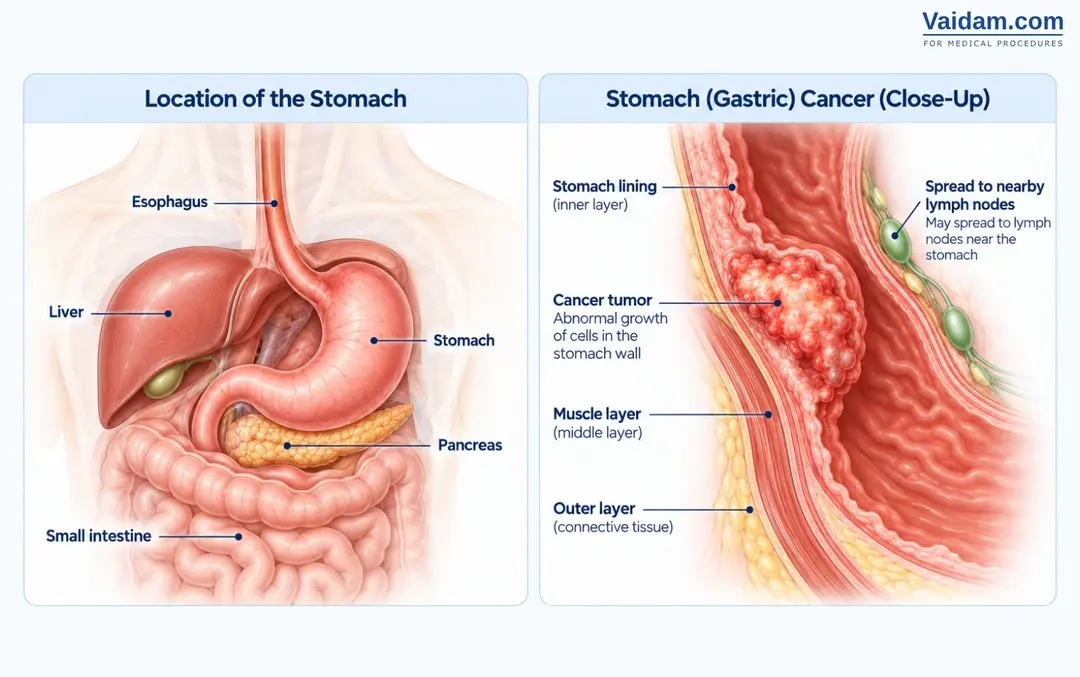
Cancers at the gastroesophageal junction, where the oesophagus meets the stomach, are often treated in a similar way.
Other tumours can also start in the stomach. They behave differently and have their own treatment pathways.
Tumour type | Where it starts | How treatment differs |
Adenocarcinoma | Gland cells in the stomach lining | Endoscopic removal, surgery, chemotherapy, targeted therapy and immunotherapy, depending on stage and biomarkers. |
Gastrointestinal stromal tumour (GIST) | Cells in the stomach wall | Mainly surgery. Targeted tablets such as imatinib for some patients. |
Neuroendocrine tumour (NET) | Hormone-producing cells | Depends on grade and spread. Options include endoscopic removal, surgery or specialised drug and radionuclide treatment. |
Gastric lymphoma | Immune cells in the stomach | Treated as a lymphoma, often without surgery. Some early cases respond to treating H. pylori infection. |
Adenocarcinoma subtypes. Pathologists often describe adenocarcinoma as an intestinal or diffuse type.
Diffuse-type cancer spreads through the stomach wall rather than forming a distinct lump.
It can be harder to see on scans, so it may need more extensive surgery.
Hereditary risk. A small number of stomach cancers are linked to inherited gene changes, such as in the CDH1 gene. The 2025 German guideline places more emphasis on genetic risk factors. Your doctors may suggest genetic counselling if you were diagnosed young or have a strong family history.
Symptoms
Early stomach cancer often causes no symptoms, or only vague ones. Symptoms that should be checked, especially if they persist, include:
indigestion or heartburn that does not settle
feeling full after small meals
loss of appetite or unexplained weight loss
upper abdominal pain
nausea or vomiting, sometimes with blood
black, tarry stools
tiredness or breathlessness from anaemia
These symptoms have many causes, and most are not cancer. Persistent symptoms, especially in older adults, should be investigated with an endoscopy.
How Stomach Cancer Is Diagnosed and Staged?
Most international patients arrive with a diagnosis already made. German team reviews these results and may repeat or add tests to complete staging before treatment starts.
Gastroscopy and biopsy. A gastroscopy (upper endoscopy) examines the stomach through a thin camera passed through the mouth. Biopsies taken during the procedure confirm the diagnosis and the tumour type.
Biomarker testing on the biopsy. Current guidance calls for testing the tumour for:
HER2, a growth protein that can be targeted with trastuzumab
MSI or mismatch repair (MMR) status, which predicts response to immunotherapy
PD-L1, reported as a CPS (combined positive score)
Claudin 18.2 (CLDN18.2), a protein that can be targeted with zolbetuximab
These results matter most for advanced disease. Increasingly, they also guide treatment before surgery. If your biopsy was done at home, ask whether these tests were performed. If not, the tissue blocks can often be sent to Germany for testing.
CT scan. A CT scan of the chest, abdomen and pelvis checks for spread to lymph nodes, the liver, the lungs and the lining of the abdomen.
Endoscopic ultrasound (EUS). EUS shows how deeply the tumour has grown into the stomach wall. It is particularly useful when endoscopic removal is being considered.
Staging laparoscopy. In this keyhole procedure, the surgeon inspects the abdomen for small deposits of cancer on the peritoneum (the abdominal lining). These deposits often do not show on scans. Staging laparoscopy is commonly recommended for locally advanced tumours before a curative plan is confirmed.
PET-CT. PET-CT is used in selected cases, not routinely.
Tumour board. All results are discussed at a multidisciplinary tumour board. Gastroenterologists, surgeons, medical and radiation oncologists, radiologists and pathologists agree on a plan together.
Stages at a glance
Stomach cancer is staged with the TNM system, which records:
how deeply the tumour has grown (T)
how many lymph nodes are involved (N)
whether it has spread to distant sites (M)
Stage | What it generally means |
Stage 0 and early stage I | Cancer confined to the inner layers of the stomach wall. |
Stages I to III | Cancer growing deeper into the wall and/or involving nearby lymph nodes, without distant spread. |
Stage IV | Spread to distant organs, such as the liver, lungs or peritoneum, or to distant lymph nodes. |
Stomach Cancer Treatment Options
Treatment depends on:
stage
tumour location and subtype
biomarker results
nutrition and general fitness
your own priorities
Not every patient receives every treatment.
Endoscopic resection for very early cancer
Some very early cancers can be removed through a gastroscope, which preserves the stomach. The two techniques are:
Endoscopic mucosal resection (EMR), which lifts and removes the lesion
Endoscopic submucosal dissection (ESD), which removes larger lesions in one piece
Endoscopic removal is limited to early tumours with favourable features, for example, small, well-differentiated tumours confined to the inner lining without ulceration. It needs an experienced endoscopist and close follow-up endoscopies afterwards. If the removed tissue shows deeper invasion than expected, surgery may still be needed.
Surgery (gastrectomy)
Surgery offers the main chance of cure for cancers that have not spread to distant sites.
Subtotal (partial) gastrectomy. Removes the lower part of the stomach, typically for tumours in the lower stomach.
Total gastrectomy. Removes the whole stomach, typically for tumours in the upper or middle stomach or for diffuse-type cancers. The oesophagus is then joined directly to the small intestine. Some centres create a small pouch to act as a food reservoir.
Lymph node removal (lymphadenectomy). The surgeon removes lymph nodes around the stomach. The number removed matters for accurate staging and for deciding on further treatment.
Surgical approaches. Gastrectomy can be done:
as open surgery
laparoscopically (keyhole)
robotically, in selected patients at experienced centres
The best approach depends on the tumour and the centre's expertise. Ask how many gastrectomies the team performs each year and what its complication rates are.
Risks. Gastrectomy is a major operation. Risks include:
leakage where the bowel is joined (anastomotic leak)
infection
bleeding
blood clots
nutritional problems afterwards
Perioperative chemotherapy (FLOT)
For most stage IB to III adenocarcinomas that can be operated on, the standard in Europe is perioperative chemotherapy: chemotherapy both before and after surgery.
The usual regimen is FLOT, a combination of 5-fluorouracil, leucovorin, oxaliplatin and docetaxel. In the German FLOT4 trial, median overall survival was 50 months with FLOT, compared with 35 months with the older ECF/ECX regimen. FLOT is usually given every two weeks, with a course before surgery and a course afterwards.
Chemotherapy before surgery aims to:
shrink the tumour
treat microscopic spread early
show how the cancer responds
Common side effects include:
tiredness
nausea
diarrhoea
mouth sores
a lower blood count, which raises infection risk
numbness or tingling in the fingers from oxaliplatin
Perioperative immunotherapy
Immunotherapy helps the immune system recognise and attack cancer cells.
In the MATTERHORN trial, adding the immunotherapy drug durvalumab to FLOT lowered the risk of the cancer progressing, recurring or causing death by 29% compared with FLOT alone. At three years, 69% of patients were alive with durvalumab plus FLOT, compared with 62% with FLOT alone. Serious side effect rates were similar in both groups.
In the EU, durvalumab is approved with FLOT for resectable stage II, III and IVA gastric and gastroesophageal junction cancers. It is given with chemotherapy before surgery and then on its own after surgery.
Whether it is recommended for you depends on your stage, biomarkers and fitness. Ask your German oncologist whether it applies to you, and how treatment after surgery would continue if you return home.
Radiotherapy
Radiotherapy has a smaller role in stomach cancer than chemotherapy. It may be used:
in selected patients, sometimes combined with chemotherapy
to control bleeding or pain from advanced disease
Treatment for advanced or metastatic stomach cancer
When cancer has spread to distant organs, treatment usually cannot cure it. Treatment can still control the cancer, relieve symptoms and extend life.
First-line treatment is usually platinum-and-fluoropyrimidine chemotherapy, with additional drugs chosen by biomarker results:
Biomarker result | What may be added to chemotherapy (ESMO guidance) |
HER2-positive | Trastuzumab, plus a PD-1 immunotherapy drug if PD-L1 CPS is 1 or higher |
HER2-negative, PD-L1 CPS 5 or higher | A PD-1 immunotherapy drug (such as nivolumab or pembrolizumab) |
HER2-negative, PD-L1 CPS 1 to 4 | A PD-1 immunotherapy drug may be considered |
CLDN18.2-positive | Zolbetuximab |
MSI-high or dMMR | A PD-1 immunotherapy drug |
Later lines of treatment may include:
paclitaxel with ramucirumab
trastuzumab deruxtecan for HER2-positive cancer
other chemotherapy
clinical trials
Peritoneal spread. For a small number of patients with limited spread to the abdominal lining, specialist centres may discuss cytoreductive surgery with HIPEC (heated chemotherapy given into the abdomen). This is a highly selective option, often considered within trials.
Palliative and supportive care. This care manages pain, eating difficulties, bleeding and blockage. It should run alongside cancer treatment, not only at the end.
Treatment by stage
This table is a simplified guide. Your own plan depends on full staging and biomarker results.
Situation | Treatment commonly considered |
Very early cancer with favourable features | Endoscopic resection (EMR/ESD). |
Early cancer not suitable for endoscopic removal | Gastrectomy with lymph node removal. Chemotherapy depends on final pathology. |
Locally advanced cancer that can be operated on (most stage IB to III) | Perioperative FLOT, with durvalumab for eligible patients, plus gastrectomy. |
Cancer that cannot be removed, or distant spread | Chemotherapy with targeted therapy or immunotherapy by biomarker. Symptom control. |
Limited peritoneal spread in selected patients | Systemic treatment first. Specialist discussion of surgery with or without HIPEC, often in trials. |
What Treatment in Germany May Involve for International Patients?
How long treatment takes?
For a locally advanced cancer treated with curative intent, the whole sequence often takes around five to six months:
Chemotherapy before surgery, usually about 8 weeks.
A break of a few weeks.
Gastrectomy and a hospital stay.
A recovery period.
Chemotherapy after surgery, usually about 8 weeks.
International patients generally choose one of two approaches:
Staying in Germany for the whole programme. This gives continuity with one team, but it costs more and means a long time away from home.
Splitting treatment. Chemotherapy is given at home under a plan agreed with the German team, and the patient travels for surgery. This works only if the home centre can deliver the same regimen and safety monitoring, and if the teams communicate well.
Discuss these options openly before you commit.
For early cancers treated by endoscopy, or for surgery alone, the stay is much shorter. For advanced disease, treatment is often ongoing, so most of it usually continues at home.
Certified stomach cancer centres
The German Cancer Society (Deutsche Krebsgesellschaft, DKG) certifies specialist stomach cancer centres (Magenkrebszentren). Certified centres are networks where all the disciplines involved in treating a cancer work closely together. They must show in an annual audit that they meet the requirements for the specific tumour type.
Asking whether a hospital holds DKG stomach cancer certification is one of the most useful checks you can make. The OncoMap directory lists certified centres.
Nutrition and rehabilitation
Nutritional support is a formal part of care in Germany. The 2025 guideline update adds supportive measures for managing malnutrition. Many patients lose weight before and after surgery, so a dietitian is usually involved throughout.
German patients often go on to inpatient rehabilitation (Anschlussheilbehandlung) after surgery. International patients can ask whether a rehabilitation stay is available and what it would cost.
Follow-up after you return home
Before discharge, you should receive:
a detailed treatment summary
the pathology report
chemotherapy records
a follow-up plan
Follow-up usually includes:
clinical reviews
blood tests
nutritional checks
imaging or endoscopy when symptoms or findings suggest it
Agree in advance how your local doctors can contact the German team.
Hospitals for Stomach Cancer Treatment in Germany
Instead of relying on rankings, check whether a hospital meets clear criteria:
DKG certification as a stomach cancer centre
a high annual volume of gastrectomies, with published complication data if available
a weekly multidisciplinary tumour board
experienced endoscopists for EMR/ESD
access to biomarker testing, including HER2, MSI/MMR, PD-L1 and CLDN18.2
dietetic and rehabilitation support
clinical trial access for advanced disease
an international patient office that can provide written cost estimates and arrange interpreters
The hospitals below are examples with verifiable, stomach-cancer-specific information. This is not a ranking or endorsement.
Hospital | City | Relevant verified information |
Heidelberg University Hospital (NCT Heidelberg) | Heidelberg | Its stomach and oesophageal cancer centre has been DKG-certified since 2024. Six departments are involved: visceral surgery, medical oncology, gastroenterology, radiotherapy, pathology and radiology. |
Charité – Universitätsmedizin Berlin | Berlin | Its surgical department lists DKG certification as a stomach cancer centre. It offers laparoscopic gastric cancer surgery and pouch reconstruction after total gastrectomy, reviews cases at an interdisciplinary tumour conference and provides second opinions. |
University Hospital Würzburg | Würzburg | Its stomach cancer centre is DKG-certified and brings together gastroenterology, general and upper GI surgery, medical oncology, radiation oncology and pathology. |
Certifications, specialists and international services change. Vaidam can confirm current details for the hospitals you are considering.
Cost of Stomach Cancer Treatment in Germany
No single fixed price applies. The total depends on your stage, treatment plan, length of stay, and hospital. However, as a rough guide, stomach cancer surgery in Germany can be listed at around €20,000 to €38,000. Perioperative chemotherapy, immunotherapy, a longer stay or rehabilitation add to this.
What affects the total cost?
Cost component | Why it varies |
Staging and diagnostics | Whether CT, EUS, staging laparoscopy, PET-CT or biomarker testing need to be repeated or added. |
Surgery | Endoscopic resection vs partial or total gastrectomy. Open, laparoscopic or robotic approach. |
Hospital stay | Length of stay after gastrectomy. Intensive care if needed. |
Chemotherapy | Number of cycles given in Germany rather than at home. |
Immunotherapy or targeted drugs | Drug, dose and duration. Often continues for months. |
Complications | Leaks, infections or nutrition problems can extend a stay. |
Rehabilitation and nutrition | Dietitian input, supplements, inpatient rehabilitation. |
Non-medical costs | Interpreters, accommodation for patient and companion, travel, visa. |
Practical tips:
Ask for separate estimates for staging, surgery and each block of chemotherapy, so you can compare staying in Germany with splitting treatment.
International bank transfers can take several working days, so arrange the advance payment early.
How International Patients Can Prepare?
Medical documents to gather
Endoscopy report and images, if available.
Pathology report from the biopsy, including tumour type and grade.
Biopsy tissue blocks or slides. German pathologists often review these and may run biomarker tests.
Biomarker results: HER2, MSI/MMR, PD-L1 CPS and CLDN18.2, if already done.
CT scans (on disc or download link, not just the report), plus EUS and PET-CT if done.
Blood tests, including blood count, liver and kidney function and albumin.
Previous treatment records, including chemotherapy regimen, number of cycles, dates and side effects.
Current medication list, with allergies.
Other medical conditions and recent weight history.
Reports in languages other than English or German may need translation. Ask the hospital which language it accepts.
Travel and administrative documents
Passport and visa. Most non-EU patients need a visa for medical treatment. Longer stays may need a national (D-type) visa rather than a short-stay Schengen visa. Applications typically need the hospital's invitation or appointment confirmation with a cost estimate, proof of financing and health insurance. Check current requirements with the German embassy or consulate.
Other items to arrange:
proof of funds or an insurer's guarantee of payment
accommodation near the hospital, especially if you will be having outpatient chemotherapy
a companion, as support is valuable after gastrectomy
Questions to Ask Your Doctor
What stage is my cancer, and has staging laparoscopy been done or is it needed?
What are my HER2, MSI/MMR, PD-L1 CPS and CLDN18.2 results, and how do they change my treatment?
Is my cancer suitable for endoscopic removal, or do I need surgery?
Do you recommend partial or total gastrectomy, and why?
Will surgery be open, laparoscopic or robotic?
How many gastrectomies does your team perform each year, and what are your leak and complication rates?
Do you recommend perioperative FLOT? Am I eligible for durvalumab?
Can I have part of my chemotherapy at home? How would you coordinate with my local oncologist?
How long will I stay in hospital after surgery, and when can I safely fly home?
What nutritional support and supplements will I need afterwards?
What follow-up will I need, and who will provide it?
What does the cost estimate include and exclude?
Recovery and Life After Treatment
In hospital. After gastrectomy, patients usually start with fluids and move gradually to soft food. Early walking and breathing exercises help reduce complications.
Eating after gastrectomy. Without a stomach, or with a smaller one, eating patterns change. The team will usually advise:
small, frequent meals, around six a day
eating slowly and chewing well
drinking between meals rather than with them
limiting very sugary foods
Dumping syndrome. This is a common after-effect when food passes into the small intestine too quickly. Symptoms include:
cramps
sweating
dizziness
diarrhoea soon after eating
It usually improves with dietary changes.
Vitamins and minerals. After total gastrectomy, the body cannot absorb vitamin B12 from food. Lifelong B12 injections or high-dose supplements are needed. Iron, calcium and vitamin D levels are also monitored.
Weight and energy. Some weight loss is expected. A dietitian can help you regain or stabilise weight. Tiredness often lasts several months, especially if chemotherapy continues after surgery.
Emotional support. Anxiety and low mood are common during and after treatment. Ask about psycho-oncology services, which are part of certified German cancer centres.
Seek prompt advice for:
persistent vomiting
difficulty swallowing
black stools
fever
increasing abdominal pain
continued weight loss
Outlook
Outlook depends most on the stage at diagnosis. The figures below are US data from the American Cancer Society, based on people diagnosed between 2015 and 2021.
Stage at diagnosis | 5-year relative survival |
Localised (confined to the stomach) | 77% |
Regional (spread to nearby tissues or lymph nodes) | 37% |
Distant (spread to distant organs) | 8% |
All stages combined | 38% |
Source: American Cancer Society, based on SEER data for people diagnosed 2015–2021.
How to read these figures:
They are averages for large groups and cannot predict an individual outcome.
They reflect treatments used several years ago. Newer approaches, such as FLOT and immunotherapy, were not yet widely used for many patients in these figures.
They are not specific to treatment in Germany.
How Vaidam Helps International Patients?
Vaidam Health is a medical travel facilitation service. It does not provide medical treatment itself. When you contact Vaidam, you are assigned a case manager who can:
share your records with top hospitals and specialists in Germany
obtain a medical opinion and written cost estimate, usually within 48 hours
help you compare hospitals against the criteria above
help with visa documentation and the hospital's invitation letter
arrange accommodation near the hospital, airport transfers and appointment scheduling
arrange interpreters (in Germany, interpreter services are chargeable)
stay in contact after you return home to help with follow-up consultations and reports
Vaidam states that its services are free for patients and do not increase the hospital bill. Treatment decisions remain with your doctors.
Frequently Asked Questions
1. How much does stomach cancer treatment cost in Germany?
There is no fixed price. However, stomach cancer surgery in Germany can range from €20,000 to €38,000. Perioperative chemotherapy, immunotherapy, a longer stay and rehabilitation add to the total. A reliable estimate requires a review of your records.
2. What is the standard treatment for stomach cancer in Germany?
It depends on the stage. Very early cancers may be removed endoscopically. Most cancers that can be operated on are treated with FLOT chemotherapy before and after gastrectomy, and durvalumab may be added for eligible patients. Advanced cancers are treated with chemotherapy combined with targeted therapy or immunotherapy according to biomarker results.
3. How long will I need to stay in Germany?
For surgery alone, plan for staging, the operation and a hospital stay of around one to two weeks, plus recovery time before flying. A full curative programme with chemotherapy before and after surgery often takes around five to six months. Some patients have part of their chemotherapy at home.
4. What is FLOT chemotherapy?
FLOT combines 5-fluorouracil, leucovorin, oxaliplatin and docetaxel. It is usually given every two weeks before and after surgery. It was developed and tested in Germany, and it is the standard perioperative regimen for most operable stomach cancers in Europe.
5. Is immunotherapy available for stomach cancer in Germany?
Yes, for eligible patients. In the EU, durvalumab with FLOT is approved for resectable stage II to IVA disease. For advanced disease, PD-1 immunotherapy is used with chemotherapy depending on PD-L1 and MSI results. Biomarker testing decides eligibility.
6. Can I live without a stomach?
Yes. After total gastrectomy, the oesophagus is joined to the small intestine, and people learn to eat smaller, more frequent meals. Lifelong vitamin B12 replacement is needed, and a dietitian helps manage weight and dumping syndrome.
7. What is the difference between partial and total gastrectomy?
A partial (subtotal) gastrectomy removes part of the stomach, usually the lower part. A total gastrectomy removes the whole stomach. The choice depends on the tumour's location, size and type.
8. Can I get a second opinion from a German specialist before travelling?
Yes. Many German hospitals offer remote second opinions based on your pathology, scans and treatment history. Sending biopsy blocks allows German pathologists to confirm the diagnosis and run biomarker tests.
9. Do I need a visa for treatment in Germany?
Most non-EU patients need a visa for medical treatment. You will usually need the hospital's invitation letter with a cost estimate, proof of funds and health insurance. Longer treatment programmes may need a national visa rather than a short-stay Schengen visa.
10. What documents should I send before travelling?
Send:
endoscopy and pathology reports
biopsy blocks or slides if requested
biomarker results
CT and other scan images
recent blood tests
previous treatment records
a medication list
Sources
Leitlinienprogramm Onkologie (DKG/Deutsche Krebshilfe/AWMF). S3-Leitlinie Magenkarzinom, Version 3.0 (May 2025) and Version 3.1 (October 2025), AWMF 032-009OL.
Deutsche Krebsgesellschaft. Press release: Aktualisierte S3-Leitlinie Magenkarzinom (5 June 2025).
Gelbe Liste. S3-Leitlinie Magenkarzinom: Update zu Diagnostik und Therapie (2025).
ESMO Gastric Cancer Living Guideline, with post-ESMO 2025 gastric cancer update summary.
Janjigian YY et al. Perioperative Durvalumab in Gastric and Gastroesophageal Junction Cancer (MATTERHORN). NEJM 2025.
AstraZeneca press release: Imfinzi approved in the EU for early gastric and gastroesophageal cancers (16 March 2026).
National Cancer Institute. Gastric Cancer Treatment (PDQ®), Health Professional Version (endoscopic resection criteria; FLOT4 outcomes).
American Cancer Society. Stomach (Gastric) Cancer Survival Rates (SEER 2015–2021).
Deutsche Krebsgesellschaft. Zertifizierung (certified centres).
NCT Heidelberg stomach cancer centre page; Charité Department of Surgery certifications page and gastric cancer service page; University Hospital Würzburg stomach cancer centre page.
Vaidam.com homepage (service descriptions).


 Chat