

"Stem cell therapy" covers treatments with very different levels of evidence.
Established: stem cell (bone marrow) transplantation for leukaemia, lymphoma, myeloma and some other blood and immune disorders. University Hospital Frankfurt performs about 80 to 100 transplants a year.
Approved for specific conditions: a small number of cell products, such as CAR-T cells for certain blood cancers and a limbal stem cell product for a rare eye injury.
Available in Germany under special national approval: Obnitix (MSC-FFM), mesenchymal stromal cells developed in Frankfurt, for a serious complication after a transplant.
Unproven: stem cell or exosome injections and infusions marketed for arthritis, Parkinson's disease, ALS, Alzheimer's disease, multiple sclerosis outside specialist transplant programmes, autism, diabetes, erectile dysfunction and anti-ageing. These are not approved medicines for these uses. The European Medicines Agency and Germany's Paul-Ehrlich-Institut have warned patients about such offers.
Costs differ widely. A stem cell transplant for leukaemia can range from €263,650.
This guide explains the types of stem cell treatment, what the evidence shows, how to check whether a treatment is approved, estimated costs and how to prepare.
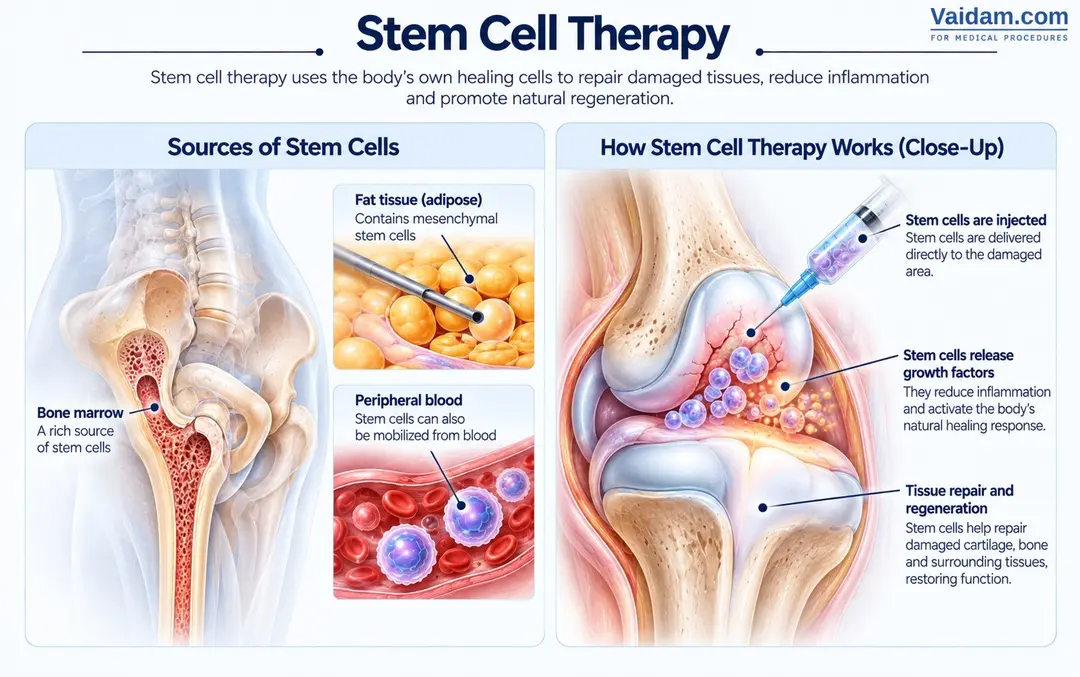
Types of Stem Cell Treatment
Treatment | What it is | Status |
Autologous stem cell transplant | High-dose chemotherapy, then the patient's own previously collected blood stem cells are returned to restore the bone marrow. | Established for myeloma and some lymphomas. Also used for selected people with highly active multiple sclerosis at specialist centres. |
Allogeneic stem cell transplant | Blood stem cells from a matched donor replace the patient's bone marrow and immune system. | Established for leukaemia, myelodysplastic syndrome, some lymphomas, aplastic anaemia, thalassaemia and inherited immune disorders. |
CAR-T cell therapy | The patient's T cells are genetically modified to attack cancer. Not a stem cell treatment, but often discussed alongside it. | EU-approved for certain lymphomas, leukaemias and myeloma. |
Mesenchymal stromal cells (MSCs) | Cells from bone marrow, fat or umbilical cord that release anti-inflammatory signals. They do not reliably turn into new tissue in the body. | Approved in Germany under special national approval for one transplant complication. For most other conditions, experimental. |
Bone marrow concentrate or fat-derived cell injections | The patient's own bone marrow or fat is processed and injected, often into a joint, on the same day. | Offered for arthritis and sports injuries. Not shown to be better than standard injections. |
Exosome products | Small particles released by cells, without the cells themselves. | No exosome product is approved in the EU. |
What the Evidence Shows?
Condition | Evidence | What this means |
Leukaemia, lymphoma, myeloma and other blood disorders | Decades of evidence and international guidelines for stem cell transplantation. | Established treatment, chosen by a transplant team according to disease and risk. |
Highly active relapsing multiple sclerosis | Randomised and registry data support autologous stem cell transplantation for carefully selected patients. | Offered only at specialist centres, with significant risks. |
Steroid-refractory acute graft-versus-host disease after transplant | Obnitix (MSC-FFM) was approved in Germany under a special national authorisation in 2019. Phase III trials are under way. | Used at transplant centres for this specific complication. |
Knee osteoarthritis | MILES trial, 480 patients (Nature Medicine, 2023): bone marrow concentrate, fat-derived cells and umbilical cord tissue injections were no better than a steroid injection for pain at 12 months, and none changed cartilage on MRI. | Not shown to regenerate cartilage or outperform standard injections. |
Crohn's disease with perianal fistulas | The only EU-approved stem cell product for this use (Alofisel) was withdrawn in December 2024 after a 568-patient trial showed no benefit over placebo. | No approved stem cell product for Crohn's disease. |
Parkinson's, Alzheimer's, ALS, stroke, spinal cord injury | Research is ongoing, mostly early-phase trials. | No approved stem cell treatment. Treatment outside a registered trial is unproven. |
Autism, cerebral palsy, diabetes, heart failure, erectile dysfunction, ageing | No convincing evidence of benefit. | Treatment outside a registered trial is unproven. |
Cartilage defects in younger patients can be treated with autologous chondrocyte implantation, which uses the patient's own cartilage cells (not stem cells). This is an approved surgical treatment, quite different from stem cell injections for arthritis.
A Warning About Unproven Stem Cell Treatments
The European Medicines Agency (EMA) warned in 2020 that unregulated cell-based therapies "may not be safe or effective". It reported serious, sometimes fatal, side effects, including infections, immune reactions, tumour formation, vision loss and bleeding in the brain.
In March 2025, Germany's Paul-Ehrlich-Institut (PEI), the federal authority for these medicines, and the EMA again warned against commercial offers of unapproved cell therapies. Warning signs they list include:
promises of healing for serious diseases without scientific evidence
"experimental therapies" offered commercially outside approved clinical trials
no confirmation of approval from the EMA or a national authority
high costs that health insurance does not cover
Legal is not the same as proven. Some cell preparations can be given legally in Germany under limited national rules, for example when made under a doctor's direct responsibility. This does not mean they have been shown to work.
Germany has seen the consequences of unregulated stem cell treatment. In 2011, health authorities in North Rhine-Westphalia closed the XCell-Center, a private clinic in Düsseldorf that had injected stem cells into the brains of children, after the death of a child.
How to check a stem cell offer?
Ask for the name of the product and whether it is approved by the European Commission (through the EMA) or by the Paul-Ehrlich-Institut, and for which condition.
If it is offered as part of a clinical trial, ask for the trial registration number and check it on the EU Clinical Trials Register or the German Clinical Trials Register (DRKS). Genuine trials do not usually charge patients for the experimental treatment.
Ask what evidence supports the treatment for your condition, and read it with your own doctor.
Be cautious of clinics that treat many unrelated conditions with the same cells.
Stem Cell Transplantation in Frankfurt
What does it involve?
Stage | What happens | Typical timing |
Evaluation | Review of diagnosis, disease status, fitness, and, for allogeneic transplant, donor search (family or registry). | About 1 to 4 weeks. Unrelated donor searches can take longer. |
Stem cell collection | For autologous transplant, the patient's stem cells are collected from the blood after mobilising injections. For allogeneic transplant, the donor's cells are collected. | A few days |
Conditioning | Chemotherapy, sometimes with radiotherapy, to prepare the bone marrow. | About 1 week |
Transplant | Stem cells are infused through a vein. | 1 day |
Engraftment | New blood cells start to grow. The patient stays in a protected unit because of infection risk. | About 2 to 4 weeks |
Early recovery | Frequent outpatient checks near the hospital. For allogeneic transplant, monitoring for graft-versus-host disease and infections. | Allogeneic transplant: often until about day 100 |
Time in Germany:
autologous transplant: often about 1 to 2 months
allogeneic transplant: often about 3 to 4 months, as early complications are most common in the first 100 days
Risks
Infections while blood counts are low
Mouth sores, nausea and tiredness from conditioning chemotherapy
Graft-versus-host disease after allogeneic transplant, where donor immune cells attack the patient's tissues
Organ damage, infertility and, rarely, graft failure
Treatment-related death, particularly after allogeneic transplant. Your team will give you an estimate for your situation.
Hospitals and Centres in Frankfurt
When choosing a centre, check:
whether it is a recognised transplant centre with experience in your condition
the number of transplants it performs each year
whether the treatment offered is an approved medicine or part of a registered trial
access to intensive care, infectious disease specialists and donor registries
whether it has an international patient office that provides written estimates and interpreters
The centres below are examples with verified information. This is not a ranking or endorsement.
Centre | Verified information |
University Hospital Frankfurt, Department of Medicine II (Haematology and Oncology) | Performs about 80 to 100 allogeneic and autologous stem cell transplants a year. Has a 10-bed transplant unit. Offers transplants from sibling and unrelated donors, as well as reduced-intensity ("mini") transplants. |
University Hospital Frankfurt, Department of Paediatrics, Stem Cell Transplantation and Immunology | Paediatric stem cell transplantation. The department developed the MSC-FFM method, now supplied as Obnitix for steroid-refractory graft-versus-host disease under a Paul-Ehrlich-Institut exemption from September 2019. |
For other stem cell offers in Frankfurt, use the checks in the warning section above. Vaidam can confirm current details and approval status for the centres you are considering.
Cost of Stem Cell Therapy in Frankfurt
Costs depend mainly on the type of treatment.
What affects the total cost?
Cost component | Why it varies |
Type of treatment | Autologous or allogeneic transplant, or another cell therapy |
Donor search | Family donor vs international registry search |
Hospital stay | Weeks in the transplant unit, intensive care if needed |
Complications | Infections, graft-versus-host disease, readmissions |
Medicines | Antimicrobials, immunosuppressants, blood products |
Non-medical costs | Accommodation for 1 to 4 months, a caregiver, interpreters, travel, visa |
How International Patients Can Prepare?
Medical documents to gather
Diagnosis and pathology reports, including bone marrow reports and genetic or molecular results.
Treatment history, with chemotherapy drugs, cycles, dates and response.
HLA typing of the patient and any siblings, if done.
Recent scans (on disc or download link) and blood tests.
Heart, lung and kidney tests, and infection screening.
For other conditions, specialist letters and imaging, and details of all previous treatments.
Reports in languages other than English or German may need translation.
Travel and administrative documents
Visa. Most non-EU patients need a visa for medical treatment. Applications usually need the hospital's invitation letter with a cost estimate, proof of funds and health insurance. Allow for the full expected stay.
Other items to arrange:
proof of funds or an insurer's guarantee of payment
accommodation near the hospital for the patient and a caregiver
a caregiver, who is essential after a transplant
Questions to Ask Before Choosing Stem Cell Treatment
Is this treatment an approved medicine for my condition, or part of a registered clinical trial? What is its name and registration number?
What evidence shows it works for my condition?
What are the risks, including serious ones?
For a transplant, what type do you recommend, and what are my chances of success and treatment-related risks?
How many patients with my condition does your centre treat each year?
How long will I need to stay in Germany?
What does the cost estimate include and exclude?
Who will manage complications after I return home?
Recovery and Follow-Up
After a transplant. Blood counts recover over weeks. Infection precautions, medicines and frequent checks continue for months. The immune system can take a year or more to recover fully, and vaccinations are repeated.
Long-term follow-up. Regular checks for relapse, late effects and, after allogeneic transplant, chronic graft-versus-host disease. Follow-up is usually shared between the German centre and your doctors at home.
After other cell treatments. Ask in advance how you will be monitored, who to contact about side effects, and how results will be measured.
How Vaidam Helps International Patients?
Vaidam Health is a medical travel facilitation service. It does not provide medical treatment itself. When you contact Vaidam, you are assigned a case manager who can:
share your records with German transplant and specialist centres for a second opinion and treatment plan
obtain a medical opinion and written cost estimate, usually within 48 hours
help you compare centres against the criteria above, including the approval status of any treatment offered
help with visa documentation and the hospital's invitation letter
arrange accommodation near the hospital, airport transfers and appointment scheduling
arrange interpreters (in Germany, interpreter services are chargeable)
stay in contact after you return home to help with follow-up consultations and reports
Vaidam states that its services are free for patients and do not increase the hospital bill. Treatment decisions remain with your doctors.
Frequently Asked Questions
1. What conditions are treated with stem cells in Frankfurt?
Established uses are stem cell transplants for leukaemia, lymphoma, myeloma and some other blood and immune disorders. For arthritis, neurological diseases, autism, diabetes and ageing, stem cell treatments are unproven and not approved medicines.
2. Does stem cell therapy work for knee arthritis?
In a large 2023 trial, bone marrow, fat-derived and umbilical cord cell injections were no better than a steroid injection for knee pain at 12 months, and none changed cartilage on MRI.
3. Can stem cells treat Parkinson's, ALS or Alzheimer's disease?
Not yet. Research is ongoing, but there is no approved stem cell treatment for these conditions. Consider treatment only within a registered clinical trial.
4. How much does stem cell therapy cost in Frankfurt?
A stem cell transplant for leukaemia can range from €263,650.
5. Is stem cell therapy legal in Germany?
Approved cell medicines and registered trials are legal. Some unapproved preparations can also be given legally under limited national rules. Legal does not mean proven. The EMA and the Paul-Ehrlich-Institut have warned against commercial offers of unapproved cell therapies.
6. How can I check whether a stem cell treatment is approved?
Ask for the product name and whether it is approved by the European Commission or the Paul-Ehrlich-Institut for your condition. For a trial, ask for the registration number and check the EU or German trial registers.
7. What are the risks of unproven stem cell treatment?
The EMA has reported infections, immune reactions, tumour formation, vision loss and bleeding in the brain, some fatal. There are also financial costs without proven benefit.
8. How long will I need to stay in Frankfurt for a stem cell transplant?
Often about 1 to 2 months for an autologous transplant and about 3 to 4 months for an allogeneic transplant.
9. Is exosome therapy the same as stem cell therapy?
No. Exosomes are small particles released by cells. No exosome product is approved in the EU.
10. Is stem cell therapy covered by insurance?
Stem cell transplants for established indications are covered by German insurance for residents. International patients usually pay themselves unless their insurer agrees in advance. Unproven stem cell treatments are not covered.
Sources
European Medicines Agency: EMA warns against using unproven cell-based therapies (28 April 2020).
Paul-Ehrlich-Institut: Vorsicht bei kommerziellen Behandlungsangeboten mit nicht zugelassenen ATMP (31 March 2025).
European Medicines Agency: Alofisel withdrawn from the EU market (December 2024).
Mautner K et al. Cell-based versus corticosteroid injections for knee pain in osteoarthritis: a randomised phase 3 trial (MILES). Nature Medicine, 2023.
Goethe University Frankfurt: Jumpstart for rapid growth (MSC-FFM and Obnitix).
Gelbe Liste: Neueinführung Obnitix bei steroid-refraktärer akuter Graft-versus-Host-Reaktion (September 2019).
University Hospital Frankfurt, Department of Medicine II: stem cell transplantation services.
University Hospital Frankfurt, Department of Paediatrics: stem cell transplantation and immunology.
kma-online: boy died after stem cell treatment (XCell-Center case, 2015). ALS-Zentrum der Charité: stem cell treatment at XCell-Center stopped.
Anova IRM: overview page (conditions listed, experimental status).
Vaidam.com homepage (service descriptions).


 Chat