

Scoliosis Treatment, Causes, Symptoms & Surgery in India
Scoliosis is a condition in which the spine is curved sideways. Usually, the spine is partially curved when looking from the side but it must appear straight when looked from the front. This article will delve into the signs & symptoms, and the treatment for scoliosis.
Possible Causes
Even though the exact cause of scoliosis cannot be determined, the most common causes are identified by the doctors and are listed below,
- Cerebral Palsy - It is a group of nervous system disorders that affect the movement, learning, hearing, vision, and thinking.
- Muscular Dystrophy - It is a group of genetic disorders that causes muscle weakness.
- Birth defects affecting the spinal cord in the infants such as in spina bifida in which there is the incomplete formation of the spinal cord.
- Other spinal injuries or infections.
- Genetic lineage in the family.
It has been observed that females are more likely to develop scoliosis than males.
Signs and Symptoms
Scoliosis is usually manifested in the form of the following symptoms,
- Tilted shoulders
- One shoulder blade may be higher than the other
- Uneven buttocks
- Uneven waistline
- Prominent ribs on one side
- The prominence of one shoulder more than the other
- Rotation of spine
- Reduced chest area for expansion of lungs causing difficulty breathing
- Back pain
If the curvature is small, it goes unnoticed unless the child reaches a growth spurt during puberty.
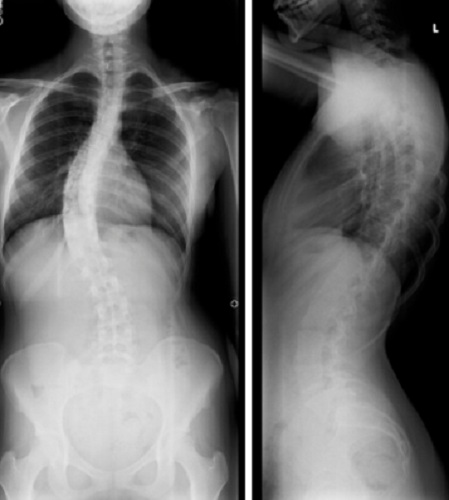
How is it Diagnosed?
The most common forms of investigations used for diagnosing scoliosis is the physical exam and the radiological examination.
The Physical Examination
This includes meticulous analysis of the back while one stands with arms at the sides. The spine curvature is well examined along with the position of the shoulders and waist. One is asked to bend forward, looking for any curvature in the upper or lower back.
There is a standard screening test called “Adam’s forward bend test”. The child is asked to bend forward with feet joined together, keeping the knees straight and arms hanging free. The doctor observes the back to look for any difference in the shape of the ribs on each side. A spinal deformity is noticed the most in this position.
Secondly, the child will need to stand in the upright position and the doctor will check if the hips and the shoulders are at the same level and if the position of the head is centered over the hips.
Lastly, any limb-length discrepancy is also looked for, along with some neurological findings or other physical problems.
Radio-Imaging Investigations
These are done to confirm the differential diagnosis made during the physical examination and include the following test,
- X-ray
- MRI scan
- CT scan
- Bone scan
Treatment
The treatment options are chosen from the least to the most invasive procedure, whatsoever is needed. Choosing the right treatment depends upon factors such as,
- Age of the patient
- The extent of curvature
- Location of the curve
- The number of remaining growing years.
- Type of scoliosis
The Treatment Options Include,
- Wait and Watch - If the spinal curvature is less than 25 degrees, or if he or she is almost fully grown, the chances of the condition getting worse are rare. One can wait and observe the condition regularly by getting checkups after every 6 to 12 months with an x-ray.
- Bracing - If the curvature lies between 25 to 45 degrees, and the child is still growing, bracing is the treatment of choice. It does not straighten the curve but prevents it from getting worse and avoid surgery. Braces are of several types. Most of them are customized according to the child.
- Surgery - This is the last option for treatment. The most common surgery is Spinal Fusion. It involves the fusion of the vertebrae together with each other by using substances such as bone graft, rods, and screws. The bone graft consists of a bone like material. The rod is used to keep the spine in the straight position and screws are used to hold them in place. As time progresses, the bone graft gets fused with the vertebrae and the rod can be adjusted at various stages as the child grows. It is done by the best spine surgeons in India.
Some of the risks associated with the surgery are,
- Excessive bleeding
- Delayed healing
- Infection
- Pain
- Damage to the surrounding nerve
Cost in India
Several latest methods to treat scoliosis are available in India at reasonable prices. The scoliosis spine surgery cost in India ranges from 11,000 to 14,000 USD. The cost is approximately 60-80% less than that in the US. The variation in the cost happens according to various factors such as the city, the hospital, expertise of the doctor, type of treatment, and complexity of the case. One of the key attributes of the best spine surgery hospitals in India is that they should have the best doctors on board. Medical tourists can easily find the best hospitals that provide cost-effective services.
Written by
Dr. Kavreen Arora
Vaidam Health · Updated 25 Sept 2026
Content meets the Vaidam Policy and is medically reviewed
Medically reviewed by
Dr. Bhawana Mittal Chat
Chat