

Radiotherapy uses precisely targeted radiation to destroy cancer cells. It can cure some cancers on its own, work alongside surgery or chemotherapy, or relieve symptoms. Radiotherapy and radiation therapy are the same treatment.
German radiation oncology departments offer:
modern external beam techniques such as IMRT, VMAT and image-guided radiotherapy
stereotactic radiotherapy and radiosurgery
brachytherapy (internal radiotherapy)
proton and carbon ion therapy, at a small number of specialised centres
For international patients, the most practical question is usually how long treatment takes. Many courses are now shorter than in the past:
one week of whole-breast radiotherapy after surgery has matched three weeks in a large trial
some small tumours can be treated in one to five stereotactic sessions
other cancers still need five to seven weeks of daily treatment
Approximate prices for a full course of conventional radiotherapy in Germany are around €24,000 to €31,000 for breast or prostate cancer programmes. Proton therapy programmes can be around €80,000 to €87,000.
This guide explains the main techniques, how long they take, how proton therapy fits in, estimated costs and how to plan your stay.
How Radiotherapy Works and When Is It Used?
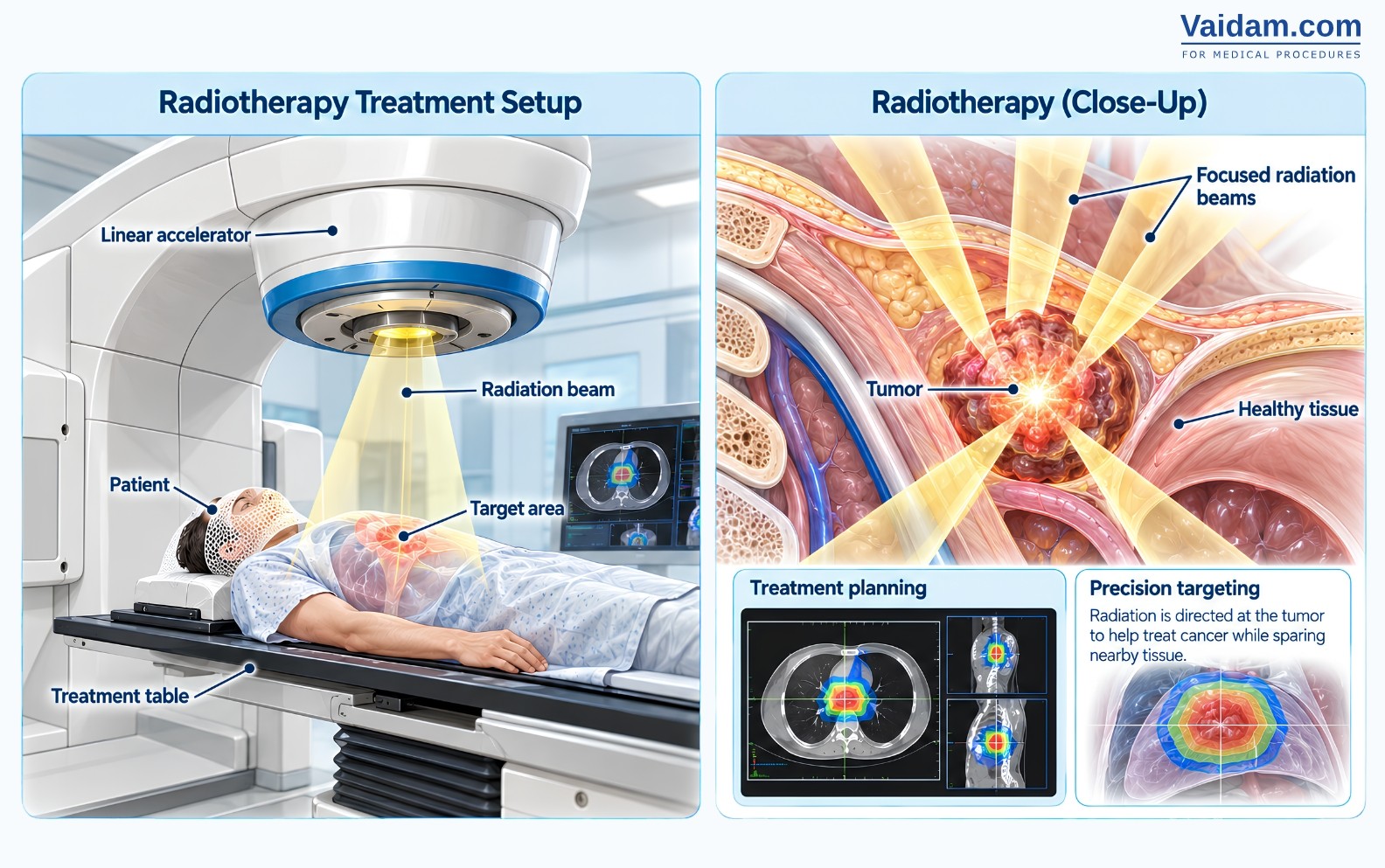
Radiation damages the DNA of cancer cells so they can no longer divide. Healthy cells are also affected, but they repair themselves better. This is why treatment is often split into many small daily doses, called fractions.
Radiotherapy may be used:
as the main treatment, for example for some prostate, head and neck, cervical, lung and skin cancers
before surgery (neoadjuvant), to shrink a tumour, for example in rectal or oesophageal cancer
after surgery (adjuvant), to lower the risk of the cancer returning, for example after breast-conserving surgery
with chemotherapy (chemoradiotherapy), to make radiation more effective
to relieve symptoms (palliative), such as pain from bone metastases, bleeding or pressure on nerves or the spinal cord
Types of Radiotherapy
External beam radiotherapy
A machine called a linear accelerator directs high-energy X-rays (photons) at the tumour from outside the body. This is the most common type of radiotherapy. Most modern treatment uses these techniques together:
IMRT (intensity-modulated radiotherapy) shapes the dose closely around the tumour, reducing the dose to nearby organs.
VMAT (volumetric modulated arc therapy) is a form of IMRT delivered while the machine rotates. It is usually quicker per session.
IGRT (image-guided radiotherapy) uses imaging before each session to check the tumour's position and correct small shifts.
IMRT, VMAT and IGRT are not separate treatments with separate prices. They are standard parts of modern radiotherapy in most German centres.
Stereotactic radiotherapy
Stereotactic treatment delivers a very high, precise dose to a small, well-defined target in one to a few sessions.
Stereotactic radiosurgery (SRS) treats brain metastases, some benign brain tumours such as meningiomas and acoustic neuromas, and arteriovenous malformations. It is often given in a single session. Despite the name, there is no surgery. Systems include Gamma Knife, CyberKnife and specially equipped linear accelerators.
Stereotactic body radiotherapy (SBRT or SABR) treats small tumours in the body, typically in one to five sessions. Examples are early lung cancer in patients unfit for surgery, some liver tumours, spinal metastases, a limited number of metastases (oligometastases) and, in selected men, prostate cancer.
The technology matters less than the team's experience with your type of target.
Brachytherapy (internal radiotherapy)
A radioactive source is placed inside or next to the tumour, giving a high dose that falls off quickly in surrounding tissue. It is a key part of treatment for:
cervical cancer (combined with external radiotherapy)
some prostate cancers
vaginal and some endometrial cancers
some breast, skin and oesophageal cancers
Proton and carbon ion (particle) therapy
Protons deposit most of their energy at a set depth and then stop. This reduces the dose to tissue beyond the tumour. Carbon ions are heavier particles with a stronger biological effect and are used for some tumours that respond poorly to conventional radiotherapy. Particle therapy is discussed in more detail below.
Radionuclide (systemic) therapy
Radioactive medicines are given by mouth or injection and travel to cancer cells. Examples are radioactive iodine for thyroid cancer, and targeted radioligand therapies for some prostate cancers and neuroendocrine tumours. These are usually delivered by nuclear medicine departments rather than radiotherapy departments.
How Long Does Radiotherapy Take?
This is often the deciding factor for international patients. The number of sessions depends on the cancer, the aim of treatment and the technique.
Situation | Typical number of sessions | Approximate time in treatment |
Single brain metastasis or benign brain tumour (radiosurgery) | 1 to 5 | 1 day to 1 week |
Early lung cancer, oligometastases, some liver or spine lesions (SBRT) | 1 to 8 | 1 to 2 weeks |
Whole-breast radiotherapy after breast-conserving surgery | 5 or 15 | 1 or 3 weeks |
Prostate cancer (external beam) | 5 (selected patients) to 20 to 39 | 1 to 8 weeks |
Palliative treatment of painful bone metastases | 1 to 10 | 1 day to 2 weeks |
Head and neck cancer (often with chemotherapy) | About 30 to 35 | 6 to 7 weeks |
Cervical cancer (external beam plus brachytherapy, with chemotherapy) | About 25 to 30 plus brachytherapy | 6 to 8 weeks |
Rectal cancer before surgery | 5 or about 25 to 28 | 1 or 5 to 6 weeks |
Treatment is usually given once a day, five days a week, as an outpatient. Most people stay in nearby accommodation. Add time before treatment for consultation, a planning CT scan and preparation of the plan, which often takes about one to two weeks.
Shorter courses are backed by evidence. In the FAST-Forward trial, 26 Gy in 5 fractions over one week for early breast cancer was compared with the 3-week standard. At 10 years, local recurrence was 2.0% with the one-week schedule and 3.6% with the three-week schedule, and late side effects were similar. For suitable patients, shorter courses mean less time away from home.
Ask the German team whether a shorter schedule is appropriate for you, and exactly how many weeks you need to stay.
Proton Therapy in Germany: Who Benefits?
Proton therapy is often searched for by name, but it is not the best option for every patient.
Where proton therapy has the strongest case:
children and adolescents, where reducing radiation to growing tissue lowers the risk of long-term effects and second cancers
tumours at the base of the skull and along the spine, such as chordomas and chondrosarcomas
some brain tumours, and eye tumours such as uveal melanoma
re-irradiation, and tumours next to critical structures such as the optic nerves or brainstem
Where the benefit is less clear. For many common adult cancers, including most prostate and breast cancers, modern photon techniques such as IMRT give comparable cancer control. Proton therapy is not clearly better in these cases.
In head and neck cancer, a phase III trial of 440 patients compared proton therapy with IMRT. Cancer control was similar (about 83% progression-free at three years in both groups). Fewer patients receiving proton therapy needed a feeding tube (28% vs 42%), suggesting fewer side effects in this group.
Cost and availability. Proton therapy programmes in Germany are listed at about €80,000 to €87,000.
Particle therapy centres in Germany
Centre | City | What it offers |
Heidelberg Ion-Beam Therapy Centre (HIT), Heidelberg University Hospital | Heidelberg | Protons and carbon ions. The first European centre of its kind, treating patients since 2009. About 700 patients a year, over 95% as outpatients. Courses range from 5 to 38 sessions over 1 to 6 weeks. |
West German Proton Therapy Centre Essen (WPE), University Hospital Essen | Essen | Protons. Treating patients since 2013, with about 4,000 treated by 2023. Four treatment rooms, including an eye tumour station. Over 2,000 children treated by early 2023, and described as Europe's largest radiotherapy centre for childhood cancer. |
University Proton Therapy Dresden | Dresden | Protons. Opened in 2014. |
Marburg Ion-Beam Therapy Center (MIT) | Marburg | Protons and carbon ions. Opened in 2015. |
Helmholtz-Zentrum Berlin | Berlin | Proton therapy for eye tumours. |
Side Effects of Radiotherapy
Side effects depend mainly on the area treated, the dose and the number of sessions. Most early effects start during treatment and settle within weeks after it finishes.
Area treated | Common short-term effects |
Any area | Tiredness, and skin redness or irritation in the treated area |
Head and neck | Sore mouth and throat, difficulty swallowing, dry mouth, taste changes |
Brain | Tiredness, hair loss in the treated area, headache |
Chest | Painful swallowing, cough |
Breast | Skin reddening, breast swelling |
Abdomen and pelvis | Diarrhoea, bladder irritation, nausea |
Late effects can appear months or years later. They depend on the area and may include:
dry mouth
skin and tissue changes
bowel or bladder changes
effects on fertility
rarely, a second cancer
Radiotherapy from outside the body does not make you radioactive. Brachytherapy with permanent implants and radionuclide therapy may require short-term precautions, and your team will explain them.
What Radiotherapy in Germany Involves for International Patients?
Remote review. Send your pathology, imaging and treatment history. A radiation oncologist advises whether radiotherapy is appropriate, which technique to use, and how many sessions are needed.
Consultation and consent. You meet the radiation oncologist in Germany, who confirms the plan and explains side effects.
Planning CT (simulation). A CT scan is taken in the treatment position, sometimes with a mask or cushion to keep you still. MRI or PET/CT may be fused with the planning scan. Small skin marks may be made.
Treatment planning. Physicists and doctors design the plan. This often takes several working days.
Treatment. Sessions usually take 10 to 30 minutes, most of it spent positioning. Weekly reviews check side effects.
Completion and handover. You receive a treatment summary with the doses and areas treated. This matters because any future radiotherapy anywhere must take previous doses into account.
Combined treatment. If radiotherapy is combined with chemotherapy, both are normally given at the same centre for the whole course.
Choosing a Hospital for Radiotherapy in Germany
Check whether a centre offers:
specific experience with your cancer type and the technique recommended
a multidisciplinary tumour board, ideally within a DKG-certified cancer centre
on-site brachytherapy, if your treatment needs it (for example, cervical cancer)
stereotactic expertise, for brain or body stereotactic treatment
access to proton or carbon ion therapy, only if your case is one where it adds value
an international patient office that provides a written estimate, interpreters and help with accommodation
Many university hospitals and large cancer centres in Germany have radiation oncology departments. Vaidam can confirm which centres suit your diagnosis and current availability.
Cost of Radiotherapy in Germany
No single fixed price applies. Cost depends on the cancer, the technique, the number of sessions, whether chemotherapy is combined, and the hospital. However, prices can range as follows:
a full course of conventional radiotherapy for breast or prostate cancer costs about €24,000 to €31,000
proton therapy costs about €80,000 to €87,000
Shorter stereotactic or palliative courses usually cost less than a full course.
What affects the total cost?
Cost component | Why it varies |
Technique | Conventional photon vs stereotactic vs brachytherapy vs proton or carbon ion therapy. |
Number of sessions | 1 to 5 for stereotactic courses, up to 35 to 39 for some curative courses. |
Planning and imaging | Planning CT, MRI or PET/CT fusion, repeat planning if the tumour changes. |
Combined chemotherapy | Drug costs and monitoring. |
Anaesthesia | Needed for some brachytherapy and for young children. |
Supportive care | Nutrition support, managing side effects. |
Non-medical costs | Accommodation for the whole course, a companion, interpreters, travel, visa. |
For long daily courses, accommodation can be a significant part of the total. Ask the hospital about nearby patient housing.
Insurance
Some international insurers cover radiotherapy abroad, especially with prior authorisation. Check in writing before you travel, particularly for proton therapy.
How International Patients Can Prepare?
Medical documents to gather
Pathology report confirming the cancer type.
Recent imaging (CT, MRI, PET/CT) on disc or download link, not just the reports.
Operation notes, if you have had surgery.
Previous radiotherapy records, including dose and treated area. This is essential if you have had radiotherapy before.
Chemotherapy and other drug treatment records.
Current medications, including blood thinners, and other medical conditions.
Details of any implanted devices, such as a pacemaker, because they affect planning.
Reports in languages other than English or German may need translation.
Travel and administrative documents
Visa. Most non-EU patients need a visa for medical treatment. Courses longer than about three months, or a combination of treatments, may need a national (D-type) visa rather than a short-stay Schengen visa. Applications usually need the hospital's invitation letter with a cost estimate, proof of funds and health insurance.
Other items to arrange:
proof of funds or an insurer's guarantee of payment
accommodation close to the centre for the full course
a companion, particularly for longer courses or combined chemoradiotherapy
Questions to Ask Your Radiation Oncologist
What is the aim of radiotherapy in my case: cure, reducing recurrence risk or symptom relief?
Which technique do you recommend, and why?
How many sessions will I need, and is a shorter schedule suitable for me?
How long must I stay in Germany, including planning time?
Would proton therapy offer me a real advantage over photon radiotherapy?
Will I have chemotherapy at the same time?
What side effects should I expect during treatment and later?
How will side effects be managed after I return home?
What follow-up scans will I need, and when?
Will I receive a written summary of the doses and areas treated?
What does the cost estimate include and exclude?
Recovery After Radiotherapy
Tiredness often builds during treatment and can last for several weeks afterwards. Skin reactions and other early effects usually improve within two to four weeks of finishing, but can take longer.
Practical care:
use only the skin products your team recommends on the treated area, and protect it from the sun
wear loose clothing over the treated area
eat well and drink plenty of fluids, especially during head and neck or pelvic treatment
keep gently active, as this helps with fatigue
report worsening pain, swallowing problems, fever, bleeding or severe diarrhoea
Follow-up. Response is often assessed with scans some weeks to months after treatment, because tumours can keep shrinking after radiotherapy ends. Follow-up can usually be done at home, with results shared with the German team.
How Vaidam Helps International Patients?
Vaidam Health is a medical travel facilitation service. It does not provide medical treatment itself. When you contact Vaidam, you are assigned a case manager who can:
share your records with top hospitals and radiation oncologists in Germany
obtain a medical opinion and written cost estimate, usually within 48 hours
help you compare centres against the criteria above
help with visa documentation and the hospital's invitation letter
arrange accommodation near the hospital, airport transfers and appointment scheduling
arrange interpreters (in Germany, interpreter services are chargeable)
stay in contact after you return home to help with follow-up consultations and reports
Vaidam states that its services are free for patients and do not increase the hospital bill. Treatment decisions remain with your doctors.
Frequently Asked Questions
1. How much does radiotherapy cost in Germany?
It depends on the technique and number of sessions. However, prices can range from €24,000 to €31,000 for a full course of breast or prostate radiotherapy and from €80,000 to €87,000 for proton therapy. Short stereotactic or palliative courses usually cost less.
2. How long will I need to stay in Germany for radiotherapy?
It depends on the treatment. Radiosurgery can take one day to a week. Many curative courses take three to seven weeks of daily treatment. Add about one to two weeks for consultation and planning.
3. Is proton therapy better than normal radiotherapy?
Not for everyone. Proton therapy has the clearest advantages for children, skull base and spinal tumours, some brain and eye tumours, and tumours next to critical organs. For many adult cancers, such as most prostate and breast cancers, modern photon radiotherapy gives similar cancer control at much lower cost.
4. Where is proton therapy available in Germany?
Proton therapy is offered in Heidelberg (HI; also carbon ions), Essen (WPE), Dresden, and Marburg (MI; also carbon ions). Proton therapy for eye tumours is available at Helmholtz-Zentrum Berlin.
5. What is the difference between SRS and SBRT?
Both deliver a high, precise dose in one to a few sessions. Stereotactic radiosurgery (SRS) treats targets in the brain, while stereotactic body radiotherapy (SBRT) treats small tumours elsewhere in the body, such as the lung, liver or spine.
6. Can breast radiotherapy be done in one week?
For many women after breast-conserving surgery, yes. The FAST-Forward trial showed that one week (five sessions) of whole-breast radiotherapy matched three weeks, with similar late side effects at 10 years. Your oncologist will advise whether it suits you.
7. Is radiotherapy painful?
No. The treatment itself is painless and usually takes a few minutes per session. Side effects such as skin soreness or tiredness can develop during the course.
8. Will I be radioactive after treatment?
Not after external beam radiotherapy. Some types of brachytherapy and radionuclide therapy need short-term precautions, which your team will explain.
9. Can I get a radiotherapy plan before travelling?
Yes. German centres can review your records remotely and suggest a technique, number of sessions and cost estimate. The final plan is made after the planning CT in Germany.
10. Can I have radiotherapy again if I had it before?
Sometimes. It depends on the previous dose, the area, and the time since treatment. Bring full records of previous radiotherapy, as they are essential for planning.
Sources
Brunt AM et al. FAST-Forward: 10-year efficacy and late normal tissue effects. Lancet Oncology 2026 (results as summarised by OncoDaily from ESTRO 2025). Also a DEGRO statement on the FAST-Forward 10-year data, identified via PubMed but not read in full.
MD Anderson: phase III trial of intensity-modulated proton therapy vs IMRT in oropharyngeal cancer (ASCO).
Heidelberg University Hospital: proton therapy and carbon ion therapy at HIT.
West German Proton Therapy Centre Essen (WPE) website, and German Wikipedia (WPE) for opening date, patient numbers and paediatric data.
German Wikipedia: Protonentherapie (list of German particle therapy centres).
Vaidam.com homepage (service descriptions).



 Chat
Chat