

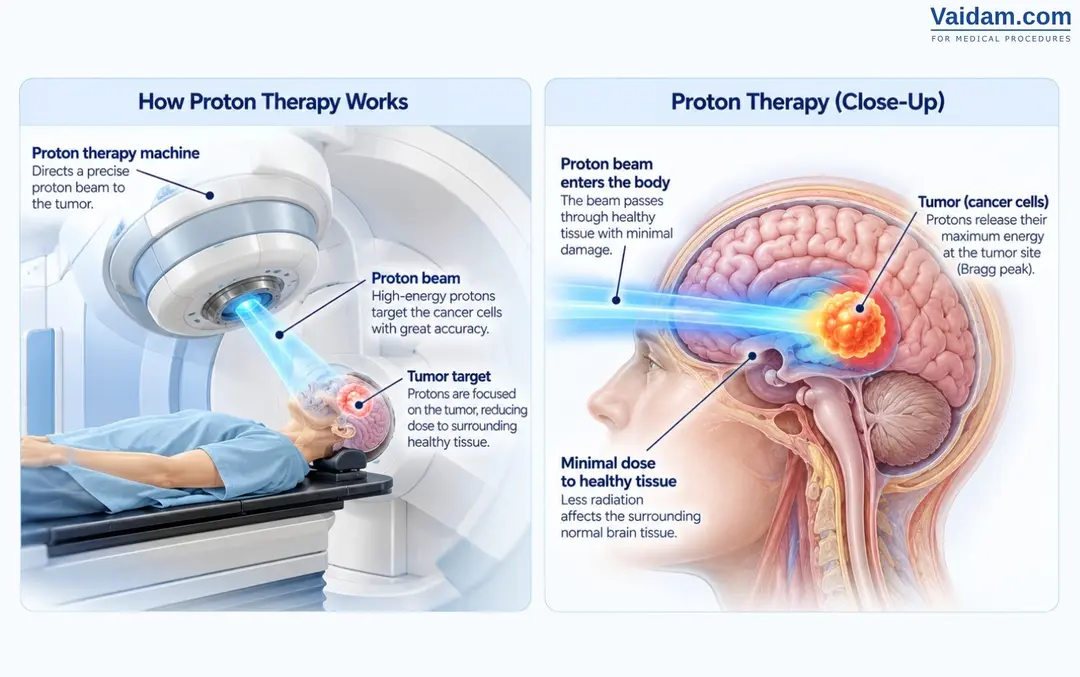
Proton therapy is a type of radiotherapy that uses protons instead of X-rays. Protons release most of their energy at a set depth and then stop, so less radiation reaches healthy tissue beyond the tumour. This matters most for:
children, whose growing tissues are more sensitive to radiation
tumours next to critical structures, such as the brainstem, spinal cord or optic nerves
Germany has four university-linked particle therapy centres treating a wide range of tumours:
Heidelberg (HIT): protons and carbon ions
Essen (WPE): protons, with Europe's largest paediatric radiotherapy programme
Dresden (UPTD): protons
Marburg (MIT): protons and carbon ions
Proton therapy for eye tumours is also available in Berlin.
Proton therapy is not better for every cancer. For many common adult cancers, including most prostate and breast cancers, modern photon radiotherapy controls the cancer equally well at a much lower cost. Centres accept patients based on expected benefit.
Estimated prices at German proton centres are around €80,000 to €87,000 for a course of treatment.
This guide explains who benefits, the German centres, carbon ion therapy, estimated costs, how long treatment takes and how to be assessed.
How Proton Therapy Works?
Conventional radiotherapy uses X-ray beams (photons). These deposit dose all the way through the body, including beyond the tumour.
Protons behave differently. They deposit relatively little energy on the way in, release most of it at a precise depth (the Bragg peak) and then stop. By adjusting the energy, the team places this peak across the tumour, so there is little or no "exit dose" beyond it.
Modern centres use pencil beam scanning, which "paints" the dose across the tumour layer by layer. Imaging checks the patient's position before each session.
The benefit is mainly in side effects, not always in cure rates. Protons reduce the dose to healthy tissue. Whether that translates into fewer side effects or better outcomes depends on the tumour's location and how close it is to sensitive organs.
Who Benefits Most From Proton Therapy?
Strongest evidence and widest acceptance
Children and adolescents, including those with medulloblastoma, ependymoma, craniopharyngioma, rhabdomyosarcoma and Ewing sarcoma. Lower doses to the developing brain, bones, and organs reduce the long-term risk of growth problems, learning difficulties, hormone problems, and second cancers.
Chordomas and chondrosarcomas of the skull base and spine, which need high doses right next to the brainstem or spinal cord.
Eye tumours, such as uveal melanoma, where proton therapy can often preserve the eye.
Some adult brain tumours, particularly lower-grade tumours in younger adults with a long expected survival.
Re-irradiation of a tumour in an area that has already received radiotherapy.
Case-by-case
Head and neck cancers. In a phase III trial of 440 patients with oropharyngeal cancer, cancer control was similar with protons and IMRT (about 83% progression-free at three years). Fewer patients needed a feeding tube with protons (28% vs 42%).
Selected tumours of the liver, pancreas, oesophagus or mediastinum, for example lymphoma in young adults, where sparing the heart, lungs or liver may matter.
Usually no clear advantage over modern photon radiotherapy
Most prostate cancers. Cancer control is similar to IMRT, and modern photon techniques, including shorter stereotactic courses, work very well.
Most breast cancers. Proton therapy may be considered in selected cases where the heart dose is a concern.
Early lung cancer and small metastases. These are generally treated with stereotactic photon radiotherapy.
Widespread metastatic cancer, where local treatment will not change the outcome.
A tumour board decides suitability based on tumour type, location, age, previous treatment and the aim of treatment.
Carbon Ion Therapy in Germany
Carbon ions are much heavier than protons. They share the proton's dose precision and also have a stronger biological effect, which may help with tumours that respond poorly to conventional radiotherapy.
In Germany, carbon ions are available at Heidelberg (HIT) and Marburg (MIT). This is unusual worldwide.
Carbon ions are used most for:
chordoma and chondrosarcoma of the skull base, spine and sacrum
adenoid cystic carcinoma and other salivary gland tumours
some sarcomas
recurrent tumours after previous radiotherapy
Evidence. A 2023 evidence review of skull base tumours reported the following local control with carbon ions:
Tumour | 5-year local control | 10-year local control |
Chordoma | 80% | 56% |
Chondrosarcoma | 89% | 88% |
There are still no completed randomised trials directly comparing carbon ions with protons. Randomised trials in Heidelberg for chordoma and chondrosarcoma have been registered. The choice between protons and carbon ions is made by the centre.
Proton and Particle Therapy Centres in Germany
Centre | City | Particles | Verified information |
Heidelberg Ion-Beam Therapy Centre (HIT), Heidelberg University Hospital | Heidelberg | Protons and carbon ions | Treating patients since 2009, the first centre of its kind in Europe. About 700 patients a year, more than 95% as outpatients. Courses of 5 to 38 sessions over 1 to 6 weeks. Treats salivary gland and ENT tumours, chordomas, chondrosarcomas, and brain, prostate, pancreatic, liver, and lung tumours, as well as lymphomas. Has an international patient service. |
West German Proton Therapy Centre Essen (WPE), University Hospital Essen | Essen | Protons | First patients in May 2013. About 4,000 patients treated by August 2023. Four treatment rooms, three with rotating gantries and one with an eye tumour station. More than 2,000 children treated by early 2023, about half under sedation. Described as Europe's largest radiotherapy centre for childhood cancer. |
University Proton Therapy Dresden (UPTD), University Hospital Carl Gustav Carus | Dresden | Protons | Treating patients since September 2014. Treats children and adolescents. Linked to OncoRay, the national centre for radiation research in oncology. |
Marburg Ion-Beam Therapy Center (MIT) | Marburg | Protons and carbon ions | Treating patients since October 2015. Four treatment rooms. Germany's second centre offering carbon ions. Operated by Rhön-Klinikum AG in 2019. |
Helmholtz-Zentrum Berlin | Berlin | Protons | Proton therapy for eye tumours. |
Note on Munich. The Rinecker Proton Therapy Centre in Munich closed at the end of 2019. Older websites may still list it.
How to choose between centres:
Children: a centre with an established paediatric programme and sedation service, such as Essen, Heidelberg or Dresden.
Chordoma, chondrosarcoma, adenoid cystic carcinoma or re-irradiation: a centre that can offer both protons and carbon ions, such as Heidelberg or Marburg.
Eye tumours: a centre with an eye treatment station, such as Essen or Berlin.
Other cases: send your records to more than one centre. Suitability, waiting times and international patient capacity differ.
What Proton Therapy in Germany Involves?
Remote suitability review. You send pathology, imaging and treatment history. The centre's tumour board decides whether proton or carbon ion therapy offers you a meaningful benefit.
Consultation. You meet the radiation oncologist in Germany. Children may also meet the anaesthesia team.
Planning. A planning CT, often with MRI, is done in the treatment position. A mask or body mould keeps you still. Planning usually takes about one to two weeks.
Treatment. Sessions are usually given once a day, five days a week. Time on the table is often 15 to 30 minutes, although the beam itself is on for only a few minutes. Most patients are treated as outpatients.
Completion. You receive a written summary with doses and treated areas, and a follow-up plan.
How long do I need to stay in Germany?
Treatment course: at Heidelberg, courses range from 5 to 38 sessions over one to six weeks. Many curative courses take five to seven weeks.
Planning and assessment: add about one to two weeks.
Children: often need longer, especially if treated under sedation or combined with chemotherapy.
Plan for accommodation for the whole period. Most children and many adults travel with a companion.
Side Effects
Side effects depend on the area treated. They are often milder than with photon radiotherapy in the same area, but they still occur.
Short-term: tiredness, skin redness in the treated area, hair loss where the beam enters. Depending on the site, there may also be a sore mouth or throat, nausea, diarrhoea or bladder irritation.
Longer-term: depends on the area, and may include hormone changes after brain treatment, hearing effects, tissue scarring and, rarely, nerve damage.
Proton therapy aims to reduce these risks, especially in children, but cannot remove them.
Cost of Proton Therapy in Germany
No single fixed price applies. Cost depends on the tumour, the number of sessions, whether sedation is needed, any additional treatment and the centre. Estimated prices for a course of proton therapy at German centres are around €80,000 to €87,000.
What affects the total cost?
Cost component | Why it varies |
Number of sessions | 5 to about 38, depending on the tumour and dose |
Particle type | Protons or carbon ions |
Sedation or anaesthesia | Often needed daily for young children |
Combined treatment | Chemotherapy, surgery or other radiotherapy |
Imaging | Repeat MRI or CT during treatment |
Non-medical costs | Accommodation for several weeks, a companion, interpreters, travel, visa |
Insurance
Some international insurers cover proton therapy abroad with prior approval, particularly for children and recognised indications. Obtain written confirmation before you travel.
How International Patients Can Prepare?
Medical documents to gather
Pathology report, including molecular results if available.
MRI and CT images (on disc or download link, not just reports), plus PET/CT if done.
Operation notes, if you have had surgery.
Full records of any previous radiotherapy, including dose, area and dates. This is essential for re-irradiation.
Chemotherapy records, and the plan for any ongoing treatment.
Current medications and other medical conditions.
For children: growth, hormone and neurodevelopmental assessments, if available.
Reports in languages other than English or German may need translation.
Travel and administrative documents
Visa. Most non-EU patients need a visa for medical treatment. A national (D-type) visa may be needed for longer stays, or if you plan to combine treatments. Applications usually need the centre's invitation letter with a cost estimate, proof of funds and health insurance.
Other items to arrange:
proof of funds or an insurer's guarantee of payment
accommodation near the centre for the full course
school or care arrangements for children and siblings
Questions to Ask the Proton Centre
Will proton or carbon ion therapy give me a real advantage over photon radiotherapy, and why?
How many patients with my tumour type do you treat each year?
Do you recommend protons or carbon ions for me?
How many sessions will I need, and how long will I stay in Germany?
For children: will sedation be needed, and do you have a paediatric programme?
Is chemotherapy or surgery needed alongside treatment, and where will it happen?
What side effects should I expect during treatment and later?
What follow-up will I need, and can it be done at home?
Is there a waiting time before I can start?
What does the cost estimate include and exclude?
How Vaidam Helps International Patients?
Vaidam Health is a medical travel facilitation service. It does not provide medical treatment itself. When you contact Vaidam, you are assigned a case manager who can:
share your records with German proton and particle therapy centres for a suitability review
obtain a medical opinion and written cost estimate
help you compare centres against the criteria above
help with visa documentation and the centre's invitation letter
arrange accommodation near the centre, airport transfers and appointment scheduling
arrange interpreters (in Germany, interpreter services are chargeable)
stay in contact after you return home to help with follow-up consultations and reports
Vaidam states that its services are free for patients and do not increase the hospital bill. Suitability and treatment decisions remain with the treating centre.
Frequently Asked Questions
1. Is proton therapy better than conventional radiotherapy?
It depends on the tumour. Proton therapy lowers the dose to healthy tissue, which matters most for children and tumours next to critical structures. For many common adult cancers, such as most prostate and breast cancers, modern photon radiotherapy gives similar cancer control at lower cost.
2. Where is proton therapy available in Germany?
Proton therapy is available at Heidelberg (HIT), Essen (WPE), Dresden (UPTD) and Marburg (MIT). Heidelberg and Marburg also offer carbon ions. Proton therapy for eye tumours is available at Helmholtz-Zentrum Berlin. The Munich proton centre closed in 2019.
3. How much does proton therapy cost in Germany?
Estimated prices at German centres are around €80,000 to €87,000 for a course of treatment. The final price depends on the number of sessions, sedation needs and the centre's estimate.
4. What is carbon ion therapy?
Carbon ion therapy uses heavier particles than protons and has a stronger biological effect. In Germany, it is available at Heidelberg and Marburg. It is used mainly for chordoma, chondrosarcoma, salivary gland tumours, some sarcomas and recurrent tumours.
5. Is proton therapy available for children in Germany?
Yes. Children are among those who benefit most. Essen (WPE) had treated more than 2,000 children by early 2023, and Heidelberg and Dresden also treat children and adolescents.
6. How long does proton therapy take?
Courses range from a few sessions to about 38, usually given over one to seven weeks. Add about one to two weeks for assessment and planning.
7. Can proton therapy be used if I have had radiotherapy before?
Sometimes. Re-irradiation is one situation where proton or carbon ion therapy may help, because it limits extra dose to tissue already treated. Full records of previous radiotherapy are essential.
8. Is proton therapy painful?
No. Treatment is painless. Discomfort may come from lying still in a mask or mould, and from side effects that develop during the course.
9. Is proton therapy experimental?
No. It is an established treatment for many indications, such as childhood tumours, chordoma, chondrosarcoma and eye tumours. For other cancers, evidence is still developing, and centres decide on a case-by-case basis.
10. How do I find out if proton therapy is right for me?
Send your pathology, scans and treatment history for review by a German particle therapy centre. Its tumour board will advise whether proton or carbon ion therapy offers you a meaningful benefit.
Sources
Heidelberg University Hospital: proton therapy and carbon ion therapy at HIT (opening, patient numbers, course length, indications, international patients).
West German Proton Therapy Centre Essen (WPE) website, and German Wikipedia (WPE) for opening date, patient numbers, treatment rooms and paediatric data.
University Hospital Dresden: Universitäts Protonen Therapie Dresden pages, and German Wikipedia (UPTD).
German Wikipedia: Marburger Ionenstrahl-Therapiezentrum.
German Wikipedia: Protonentherapie (list of German centres, Rinecker closure). Online petition on the Munich proton centre closure (end of 2019).
MD Anderson: phase III trial of proton therapy vs IMRT in oropharyngeal cancer.
Carbon Ion Radiotherapy: An Evidence-Based Review and Summary Recommendations for Skull-Base Chordomas and Chondrosarcomas. Cancers (MDPI) 2023.
Vaidam.com homepage (service descriptions).



 Chat