


Chronic back pain, leg pain, numbness, or difficulty walking can slowly take away comfort and mobility. For patients travelling from overseas, concerns go beyond just pain relief. The safety of surgery, a predictable recovery, a shorter hospital stay, and the ability to return home on time all matter greatly.
Minimally Invasive Spine Surgery (MISS) offers a treatment option for selected spine conditions using smaller incisions and muscle-sparing techniques, helping many eligible patients recover more comfortably.
Manipal Hospitals, one of India’s leading healthcare networks, provides advanced spine care using modern minimally invasive and endoscopic techniques. Each treatment plan is carefully chosen based on medical evaluation, making these approaches especially suitable for eligible international patients seeking organised and reliable spine treatment in India.
In this blog, we explain what minimally invasive spine surgery involves, who may benefit from it, why overseas patients choose Manipal Hospitals, and what to expect when planning spine surgery in India.
What is Minimally Invasive Spine Surgery (MISS)
Minimally Invasive Spine Surgery (MISS) refers to a group of surgical techniques that allow surgeons to access the spine through small incisions, using specialised instruments, microscopes, or endoscopic cameras. The aim is to reach the affected area while minimising disruption to surrounding muscles and soft tissues.
Compared to traditional open spine surgery, MISS may offer:
- Less muscle injury
- Reduced post-operative pain in many cases
- Earlier mobilisation
- Shorter hospital stay for selected procedures
MISS is not suitable for all spine conditions. A thorough evaluation of MRI or CT scans, clinical symptoms, spinal stability, and overall health is essential before deciding on the surgical approach.
At Manipal Hospitals, spine surgeons recommend minimally invasive or endoscopic procedures only when medically appropriate, prioritising safety and long-term outcomes.
Why International Patients Choose Manipal Hospitals for Spine Surgery
There are several reasons behind this preference:
1. Advanced Minimally Invasive Spine Techniques
Manipal Hospitals offer a range of modern spine procedures, including:
- Endoscopic spine surgery
- Microscopic microdiscectomy and nerve decompression
- Minimally invasive spine fusion techniques, such as TLIF, PLIF, and OLIF, in selected cases
These techniques aim to treat the source of pain while preserving typical spinal structures as much as possible.
2. Faster Recovery for Overseas Patients
International patients often need to carefully plan their stay. Minimally invasive spine surgery may help by:
- Allowing earlier walking and physiotherapy
- Reducing post-operative discomfort in many cases
- Shortening hospital stay for suitable procedures
Recovery timelines vary depending on the type of surgery. Simple decompression procedures often lead to faster recovery than multi-level fusion surgeries. Fitness to travel is decided by the treating team based on individual recovery.
3. Dedicated International Patient Services
Manipal Hospitals provides structured support for international patients, including:
- Pre-arrival medical case review
- Assistance with medical visas and travel planning
- Airport pickup and nearby accommodation support
- Language interpreters, when required
- Guidance on post-discharge follow-up
This coordinated approach helps patients focus on treatment and recovery rather than logistics.
Spine Conditions Commonly Treated with MISS at Manipal Hospitals
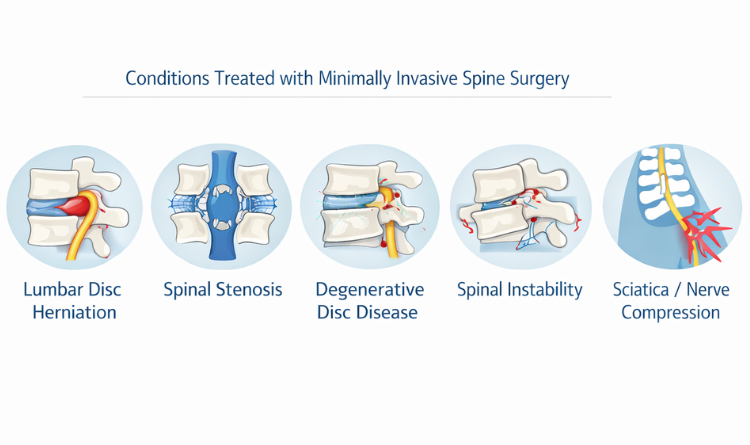
Not all spine problems require surgery, and not every surgical condition requires an open approach. MISS may be considered for selected patients with:
- Lumbar disc herniation causing back pain or sciatica
- Spinal stenosis with nerve compression
- Degenerative disc disease in selected cases
- Spinal instability requiring minimally invasive fusion
- Certain spinal fractures or compression fractures
- Selected spinal tumours or infections in carefully chosen cases, depending on location and spinal stability
The final decision depends on symptom severity, imaging findings, bone quality, spinal alignment, and any prior spine surgery. The goal is safe pain relief, early mobilisation, and functional recovery.
Endoscopic and “Keyhole” Spine Surgery at Manipal Hospitals
Many patients search for keyhole spine surgery, a common term used to describe spine procedures performed through tiny incisions.
What Is Endoscopic Spine Surgery?
Endoscopic spine surgery uses a thin camera (endoscope) inserted through a small incision. The surgeon visualises the spine on a screen and treats the problem using specialised instruments.
Endoscopic techniques may be suitable for:
- Disc herniation
- Certain nerve compressions
- Selected cases of spinal stenosis
Potential benefits for eligible patients include:
- Tiny incision
- Minimal muscle disruption
- Faster mobilisation
- Reduced post-operative discomfort
Not all spine problems can be treated endoscopically. The surgeon will advise whether this approach is safe and effective for your condition.
Types of Minimally Invasive Spine Procedures Offered
Minimally invasive spine care at Manipal Hospitals may consist of:
1. Minimally Invasive Decompression
Used to relieve nerve pressure caused by a disc bulge or spinal stenosis through small tubular retractors or microscope-assisted techniques.
2. Endoscopic Spine Surgery
Camera-assisted procedures are performed through small incisions for selected disc and nerve conditions.
3. Minimally Invasive Spine Fusion
Used in cases of instability, employing smaller incisions and reduced tissue disruption compared to traditional open fusion.
4. Image-Guided Non-Surgical Procedures
Image-guided injections or radiofrequency treatments may be recommended for pain control when surgery is not immediately required.
Why Recovery Can Be Faster with MISS
One of the most significant advantages of MISS is reduced trauma to muscles and soft tissues. This often leads to:
- Earlier walking after surgery
- Reduced pain medication requirement in many cases
- Faster return to basic daily activities
- Shorter hospital stay, depending on the procedure
Recovery varies based on diagnosis and procedure type. Surgeons at Manipal Hospitals clearly explain realistic recovery timelines, especially for international patients planning travel.
What International Patients Can Expect: Step-by-Step Journey
From initial consultation through recovery and follow-up, Manipal Hospitals offers a structured, well-coordinated care pathway for international patients.
- Online Case Review: MRI scans, reports, and medical history are reviewed before travel to assess suitability for minimally invasive spine surgery.
- Treatment Plan & Cost Guidance: Patients receive details about the likely procedures, hospital stay, recovery timeline, and follow-up needs.
- Travel & Arrival in India: The international patient team assists with visa support, airport pickup, and nearby accommodation.
- Final Evaluation & Surgery: After clinical assessment and any required tests, surgery is scheduled if appropriate.
- Recovery & Follow-Up: Guidance is provided on wound care, activity limits, physiotherapy, safe travel timing, and online follow-up after returning home.
This step-by-step approach helps ensure clarity, safety, and continuity of care throughout the treatment journey.
Who May Be a Suitable Candidate for MISS?
You may be considered for MISS if:
- Imaging findings clearly explain symptoms
- Only limited spinal levels are involved
- There is no severe spinal deformity
- Bone quality and general health are suitable
- Post-operative rehabilitation can be followed
Open or alternative surgery may be recommended if the condition is complex, extensive, or unstable. The safest approach is always prioritised over the least invasive option.
Practical Tips for Overseas Patients
Overseas patients may benefit from planning a few practical aspects to ensure a safe and comfortable treatment journey in India.
- Carry original MRI/CT images and reports
- Ask about the total stay duration in India
- Plan for a caregiver if required
- Confirm post-discharge travel clearance
- Understand follow-up care after returning home
Taking these simple steps in advance can help you focus on treatment and recovery, while avoiding unnecessary stress during your stay in India.
Final Thoughts
For carefully selected patients, Minimally Invasive Spine Surgery at Manipal Hospitals offers a balance of advanced technology, experienced surgical care, and structured recovery planning.
Whether you are exploring MISS surgery at Manipal Hospital, endoscopic spine surgery in India, or keyhole spine surgery for international patients, a thorough medical evaluation is the most essential first step.
When performed for the proper indication and the right patient, minimally invasive spine surgery can improve comfort, mobility, and overall quality of life.


 Chat
Chat