

Lung cancer treatment depends on three things: the type (non-small cell or small cell), the stage, and the results of molecular testing of the tumour.
Early-stage non-small cell lung cancer (NSCLC) is usually removed surgically. This is often a lobectomy by keyhole (VATS) or robotic surgery. Immunotherapy or targeted therapy may be given before or after surgery.
Stage III NSCLC that cannot be operated on is usually treated with chemoradiotherapy, followed by immunotherapy (durvalumab), or osimertinib for EGFR-mutated tumours.
Advanced NSCLC is treated according to the tumour's gene changes. Patients with EGFR, ALK or other drivers receive targeted tablets. Most others receive immunotherapy, often with chemotherapy.
Small cell lung cancer (SCLC) is treated with chemotherapy, often with radiotherapy and immunotherapy.
Germany has two measurable quality standards for lung cancer care:
Since 2025, hospitals must perform at least 75 lung cancer operations a year to be allowed to operate.
A national network, the nNGM, provides broad molecular testing through more than 30 centres.
Estimated prices for VATS or robotic lobectomy in Germany are around €25,000 to €39,000, depending on the extent of surgery.
This guide explains how treatment is chosen at each stage, what care in Germany involves, estimated costs and how to prepare.
What Is Lung Cancer?
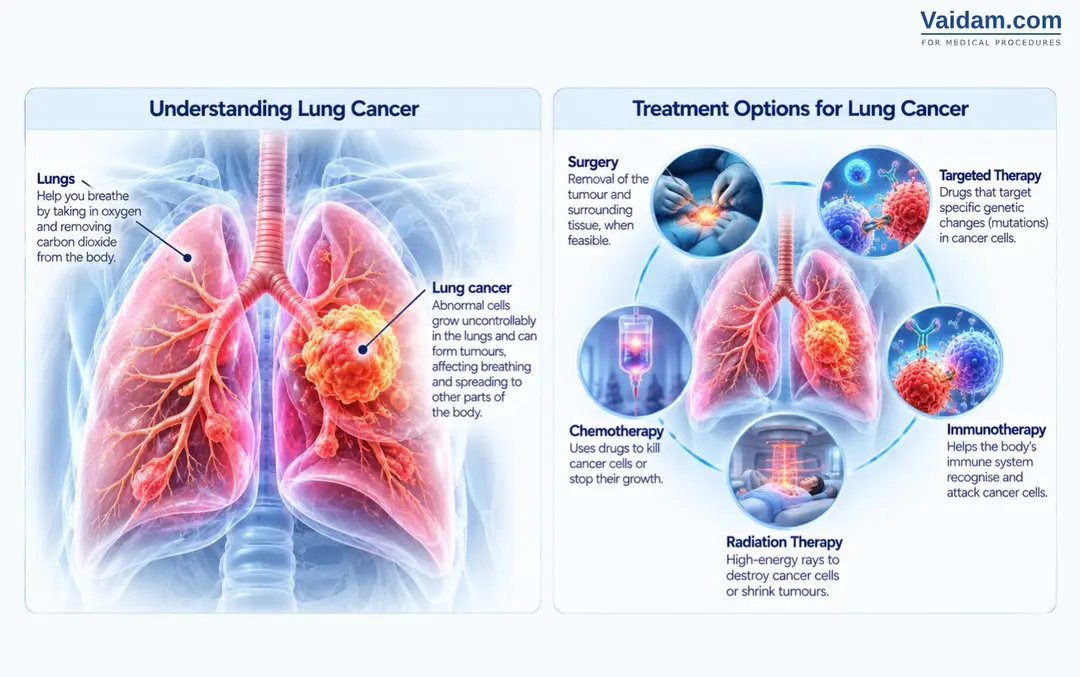
The lungs are part of the respiratory system and are responsible for bringing oxygen into the body and removing carbon dioxide. Lung cancer is a type of cancer that begins when abnormal cells in the lungs grow uncontrollably and form a tumour.
Lung cancer can develop in different types of cells in the lungs and may spread to nearby tissues, lymph nodes, or other parts of the body. Smoking is the main risk factor, although lung cancer can also occur in people who have never smoked.
Types of Lung Cancer
The two main types are non-small cell lung cancer (NSCLC) and small cell lung cancer (SCLC), which differ in how they grow, spread, and respond to treatment.
Type | Share of cases | Key facts |
Non-small cell lung cancer (NSCLC) | About 85% | Includes adenocarcinoma (most common, including in non-smokers), squamous cell carcinoma and large cell carcinoma. Molecular testing is essential in advanced adenocarcinoma. |
Small cell lung cancer (SCLC) | About 10 to 15% | Grows and spreads quickly. Strongly linked to smoking. Treated mainly with chemotherapy, radiotherapy and immunotherapy. |
Rarer tumours, such as carcinoid tumours and mesothelioma, are treated differently.
Symptoms may include:
a persistent or changing cough
coughing up blood
breathlessness
chest pain
hoarseness
weight loss
repeated chest infections
Early lung cancer often causes no symptoms.
Diagnosis, Staging and Molecular Testing
CT scan of the chest and upper abdomen, and PET-CT to check for spread.
MRI of the brain, for staging in many patients.
Biopsy by bronchoscopy, endobronchial ultrasound (EBUS) or CT-guided needle. EBUS also samples lymph nodes in the chest, which is crucial for accurate staging.
Lung function tests to check whether surgery is safe.
Molecular (biomarker) testing
For non-squamous NSCLC, and in some other cases, tumour tissue or blood (liquid biopsy) is tested with broad next-generation sequencing (NGS) panels. Gene changes that can be targeted with medicines include:
EGFR, ALK, ROS1, BRAF V600E, KRAS G12C, MET exon 14, RET, NTRK and HER2
PD-L1 testing guides immunotherapy.
Germany's national Network Genomic Medicine – Lung Cancer (nNGM) coordinates this testing. It links more than 30 network centres with about 500 partner hospitals and practices, so that patients across Germany can access modern molecular diagnostics and targeted therapies.
For international patients: if your tumour has not had broad molecular testing, ask whether it can be done in Germany on your existing biopsy blocks. It can change treatment significantly.
Treatment for Non-Small Cell Lung Cancer
Stages I to II: surgery-based treatment
Surgery is the standard for patients fit enough.
Lobectomy (removal of one lobe of the lung) with lymph node removal is the usual operation.
Segmentectomy removes a smaller section of lung. It may suit selected small tumours.
Pneumonectomy removes a whole lung. It is used only when necessary.
Most lobectomies at experienced centres are done by VATS (video-assisted keyhole surgery) or robotic surgery, which can speed recovery.
Stereotactic radiotherapy (SBRT) is the main alternative for patients who cannot have surgery.
Treatment around surgery
This depends on the stage and tumour biology:
Immunotherapy with chemotherapy before surgery, often continued afterwards. Examples are durvalumab (EU approval April 2025 for resectable high-risk NSCLC without EGFR or ALK changes), pembrolizumab and nivolumab. In the AEGEAN trial, adding durvalumab reduced the risk of recurrence, progression or death by 32%.
Osimertinib after surgery for EGFR-mutated tumours (ADAURA trial).
Alectinib after surgery for ALK-positive tumours (ALINA trial).
Chemotherapy after surgery, for some patients.
Stage III
Operable Stage III. Some patients have treatment before surgery (chemotherapy with immunotherapy), then surgery. Tumour board decisions are especially important here.
Inoperable Stage III. Chemoradiotherapy, then durvalumab consolidation. For EGFR-mutated tumours, osimertinib is used after chemoradiotherapy instead. In the LAURA trial, median progression-free survival was 39.1 months with osimertinib vs 5.6 months with placebo.
Stage IV (advanced) NSCLC
With a targetable gene change:
Gene change | Examples of targeted treatment |
EGFR (common mutations) | Osimertinib, alone or with chemotherapy. Amivantamab with lazertinib (EU approval January 2025). |
ALK | Alectinib, brigatinib, lorlatinib. |
ROS1 | Crizotinib, entrectinib, repotrectinib. |
BRAF V600E | Dabrafenib with trametinib. |
KRAS G12C | Sotorasib, adagrasib (usually after first-line treatment). |
MET exon 14, RET, NTRK, HER2 | Specific targeted drugs, depending on EU approval. |
Without a targetable change: immunotherapy, such as pembrolizumab alone for high PD-L1, or immunotherapy combined with chemotherapy.
Later options include other chemotherapy, antibody-drug conjugates and clinical trials.
Radiotherapy and local treatment can control brain metastases, bone pain or limited metastases (oligometastatic disease).
Treatment for Small Cell Lung Cancer
Limited stage. Chemotherapy with radiotherapy. Since March 2025, durvalumab has been approved in the EU for patients whose cancer has not progressed after chemoradiotherapy. In the ADRIATIC trial, median overall survival was 55.9 months vs 33.4 months with placebo. Brain radiotherapy may be offered to prevent metastases.
Extensive stage. Chemotherapy with immunotherapy (atezolizumab or durvalumab), then immunotherapy maintenance.
After progression. Tarlatamab, a T-cell engager, was approved in the EU in June 2026 after platinum chemotherapy. In the DeLLphi-304 trial, median overall survival was 13.6 months vs 8.3 months with chemotherapy.
Unproven Treatments: A Warning
Some websites promote dendritic cell vaccines or other cell therapies for lung cancer. These are not approved standard treatments.
The European Medicines Agency has warned about unregulated cell therapies being sold in Europe. Ask whether any treatment offered is EMA-approved or part of a registered clinical trial. Genuine clinical trials in Germany are listed in the German Clinical Trials Register (DRKS) and on ClinicalTrials.gov.
Supportive and Palliative Care
Important throughout treatment:
smoking cessation, which improves outcomes after surgery and radiotherapy
managing breathlessness and pain
treating fluid around the lung (pleural effusion)
nutrition and physiotherapy
psychological support
Palliative care alongside cancer treatment improves quality of life in advanced disease.
What Treatment in Germany Involves for International Patients?
Quality signals
Minimum surgical volume. German hospitals must perform at least 75 lung cancer operations per year per site. The requirement was phased in (40 in 2024, 75 from 2025) and was confirmed by a regional social court in February 2026.
DKG-certified lung cancer centres (Lungenkrebszentren). Certified centres hold weekly interdisciplinary tumour boards and are audited each year. They are listed on OncoMap.
Molecular testing through nNGM network centres.
Lung cancer screening in Germany
Since 1 April 2026, statutory health insurance in Germany covers annual low-dose CT screening for people who meet all of these criteria:
aged 50 to 75
a heavy smoking history of at least 25 years and 15 pack-years
either still smoking or quit within the last 10 years
This is a programme for people insured in Germany. International visitors would need to pay privately for screening.
Typical time in Germany
Treatment | Typical planning |
Staging, biopsy and molecular testing | About 1 to 2 weeks. Molecular results can take longer. |
Lobectomy (VATS or robotic) | About 1 to 2 weeks including recovery, plus time to be fit to fly. |
SBRT for early lung cancer | Usually 1 to 8 sessions over 1 to 2 weeks. |
Chemoradiotherapy for Stage III | About 6 to 7 weeks, followed by up to 12 months of immunotherapy, often at home. |
Targeted therapy or immunotherapy | Ongoing. Often continued at home under a plan agreed with the German team. |
Hospitals for Lung Cancer Treatment in Germany
Check whether a hospital has:
DKG certification as a lung cancer centre
a high annual volume of lung cancer surgery, well above the legal minimum of 75
EBUS, VATS or robotic surgery and SBRT on site
broad molecular testing, such as through the nNGM network
clinical trials
an international patient office that can provide written estimates and interpreters
The hospitals below are examples with verified information. This is not a ranking or endorsement.
Hospital | City | Verified information |
Thoraxklinik Heidelberg (Lung Cancer Centre at NCT Heidelberg) | Heidelberg | DKG-certified lung cancer centre since June 2009, one of the first in Germany. Treats more than 1,000 patients with newly diagnosed lung cancer a year. Weekly interdisciplinary tumour board and daily joint indication conference. |
LungenClinic Grosshansdorf | Grosshansdorf (near Hamburg) | DKG-certified lung cancer centre since 2012, recertified without restriction in March 2025. Its mesothelioma unit was also certified. About 12,000 inpatients and outpatients a year across the clinic. |
Charité – Universitätsmedizin Berlin | Berlin | Its Comprehensive Cancer Centre includes a lung cancer organ centre and takes part in the nNGM network. |
Certifications, specialists and international services change. Vaidam can confirm current details for the hospitals you are considering.
Cost of Lung Cancer Treatment in Germany
No single fixed price applies. Cost depends on the stage, the treatment plan, the length of stay and the hospital. Estimated prices for VATS or robotic lobectomy in Germany are around €25,000. More extensive resections can cost up to €39,000.
What affects the total cost?
Cost component | Why it varies |
Diagnostics | PET-CT, EBUS, brain MRI, scope of molecular testing |
Surgery | Segmentectomy, lobectomy or pneumonectomy. VATS, robotic or open. |
Radiotherapy | SBRT (few sessions) vs chemoradiotherapy (6 to 7 weeks) |
Systemic therapy | Drug type and how many cycles or months are given in Germany |
Hospital stay | Longer after open surgery or complications |
Non-medical costs | Interpreters, accommodation, travel, a companion, visa |
How International Patients Can Prepare?
Medical documents to gather
Pathology report, with tumour type.
Biopsy blocks or slides, for review and molecular testing.
Molecular and PD-L1 results, if done, including which genes were tested.
CT and PET-CT images (on disc or download link), and brain MRI if done.
Lung function test results and heart assessments, if available.
Previous treatment records, with drugs, cycles, radiotherapy details and dates.
Smoking history, current medications and other conditions.
Reports in languages other than English or German may need translation.
Travel and administrative documents
Visa. Most non-EU patients need a visa for medical treatment. Applications usually need the hospital's invitation letter with a cost estimate, proof of funds and health insurance.
Fitness to fly. Check with your doctors about fitness to fly, especially if you are breathless or need oxygen. After lung surgery, the team will advise when it is safe to fly.
Other items to arrange:
proof of funds or an insurer's guarantee of payment
accommodation near the hospital
a companion
Questions to Ask Your Lung Cancer Team
What type and stage is my lung cancer, and has lymph node staging (EBUS or PET-CT) been done?
Has my tumour had broad molecular testing? Which genes were tested, and what did they show?
What is my PD-L1 level?
Am I a candidate for surgery, and would it be VATS, robotic or open?
Should I have immunotherapy or targeted therapy before or after surgery?
If surgery is not possible, is SBRT or chemoradiotherapy suitable?
How many lung cancer operations does your centre perform each year? Is it DKG-certified?
Am I eligible for any clinical trials?
How long will I need to stay in Germany, and can treatment continue at home?
What does the cost estimate include and exclude?
Recovery and Follow-Up
After lobectomy. Chest drains are usually removed within days. Breathing exercises and walking start early. Most people return to light activities within a few weeks.
After SBRT or chemoradiotherapy. Tiredness, cough or difficulty swallowing may occur. Inflammation of the lungs (pneumonitis) can develop weeks to months later. Report new breathlessness or fever.
On immunotherapy. Report new cough, diarrhoea, rash or unusual tiredness, as these may be immune side effects.
Follow-up. Regular CT scans, often every three to six months at first.
Outlook
Outlook depends on the type and stage at diagnosis. The figures below are US data from the American Cancer Society.
Stage at diagnosis | NSCLC 5-year relative survival | SCLC 5-year relative survival |
Localised | 67% | 34% |
Regional | 40% | 20% |
Distant | 12% | 4% |
All stages combined | 32% | 9% |
Source: American Cancer Society, SEER data for people diagnosed 2012–2021.
How to read these figures:
They are averages for large groups and cannot predict an individual outcome.
They largely predate recent treatments, such as perioperative immunotherapy, newer targeted drugs and durvalumab for limited-stage SCLC. People with targetable mutations often live considerably longer than these averages.
They are not specific to treatment in Germany.
How Vaidam Helps International Patients?
Vaidam Health is a medical travel facilitation service. It does not provide medical treatment itself. When you contact Vaidam, you are assigned a case manager who can:
share your records and scans with German lung cancer centres for a second opinion and treatment plan
obtain a medical opinion and written cost estimate, usually within 48 hours
help you compare hospitals against the criteria above
help with visa documentation and the hospital's invitation letter
arrange accommodation near the hospital, airport transfers and appointment scheduling
arrange interpreters (in Germany, interpreter services are chargeable)
stay in contact after you return home to help with follow-up consultations and reports
Vaidam states that its services are free for patients and do not increase the hospital bill. Treatment decisions remain with your doctors.
Frequently Asked Questions
1. How much does lung cancer treatment cost in Germany?
It depends on the stage and treatment. Estimated prices range from €7,100 to €8,800 for a diagnostic work-up and about €25,000 for VATS or robotic lobectomy. More extensive resections cost up to about €39,000. Immunotherapy and targeted drugs add ongoing costs.
2. Which lung cancers can be treated with surgery?
Mainly early-stage NSCLC (Stages I to II) and some Stage III tumours, in patients fit enough for surgery. SCLC is rarely treated with surgery.
3. What is VATS or robotic lobectomy?
These are keyhole operations to remove a lobe of the lung through small incisions, using a camera (VATS) or a surgical robot. Recovery is often quicker than after open surgery.
4. Why is molecular testing so important?
About a quarter or more of lung adenocarcinomas have a targetable gene change, such as EGFR or ALK. Targeted tablets for these changes often work better than chemotherapy. Testing also guides immunotherapy through PD-L1.
5. Is immunotherapy available for lung cancer in Germany?
Yes. It is used for advanced NSCLC without a targetable change, around surgery for eligible patients, after chemoradiotherapy for Stage III, and in small cell lung cancer.
6. What is new in lung cancer treatment?
Recent EU approvals include:
perioperative durvalumab for resectable NSCLC (2025)
amivantamab with lazertinib for EGFR-mutated NSCLC (2025)
durvalumab for limited-stage SCLC (2025)
tarlatamab for extensive-stage SCLC after chemotherapy (2026)
7. How do I choose a lung cancer centre in Germany?
Look for DKG certification, a surgical volume well above the legal minimum of 75 operations a year, broad molecular testing, SBRT and access to clinical trials.
8. How long will I need to stay in Germany?
About one to two weeks for staging and molecular testing, and about one to two weeks for lobectomy plus recovery. Chemoradiotherapy takes about six to seven weeks. Drug treatments can often continue at home.
9. Can I get a second opinion before travelling?
Yes. German lung cancer centres can review scans, pathology and molecular results remotely. Sending biopsy blocks allows additional molecular testing.
10. Is dendritic cell therapy an option for lung cancer?
It is not an approved standard treatment. The European Medicines Agency has warned about unregulated cell therapies sold in Europe. Genuine trials are listed in public trial registers.
Sources
Deutsches Ärzteblatt: court confirms lung cancer surgery minimum volume of 75 per year (February 2026; phase-in 2024–2025).
DKFZ: new lung cancer screening for heavy smokers starts 1 April 2026 (eligibility criteria).
nNGM: national Network Genomic Medicine Lung Cancer, patient information (more than 30 network centres, about 500 partners).
AstraZeneca: Imfinzi perioperative (AEGEAN) EU approval, 4 April 2025. Imfinzi limited-stage SCLC (ADRIATIC) EU approval, 17 March 2025.
ecancer: European Commission approves lazertinib with amivantamab (MARIPOSA), 21 January 2025.
CancerNetwork: tarlatamab EU approval for extensive-stage SCLC (DeLLphi-304), 1 June 2026.
ScienceDirect: NSCLC in 2026, a narrative review of clinical advances (ADAURA, ALINA, LAURA, perioperative immunotherapy).
American Cancer Society: Lung cancer survival rates (NSCLC and SCLC).
Thoraxklinik Heidelberg: Lung Cancer Centre at NCT Heidelberg. LungenClinic Grosshansdorf: recertification (March 2025).
Pharmaceutical Technology: EMA warning on unregulated cell therapies sold in Europe.
Vaidam.com homepage (service descriptions).



 Chat