

CAR-T cell therapy uses your own immune cells (T cells), genetically modified in a laboratory to recognise and attack a marker on cancer cells. It is given as a single infusion.
Who it is for: adults and some children and young adults with certain B-cell lymphomas, B-cell acute lymphoblastic leukaemia (B-ALL) and multiple myeloma, usually after the cancer has come back or not responded to earlier treatment. For some large B-cell lymphomas and some myeloma, it is now used as early as second-line.
What it involves: collection of T cells, about 3 to 5 weeks of manufacturing, a short course of chemotherapy, the infusion, and close monitoring for side effects.
Time in Germany: usually about 2 to 3 months in total.
Quality standards: German CAR-T centres must meet binding requirements for staff, facilities and experience set by the Federal Joint Committee (G-BA).
Cost: German statutory insurers pay about €275,000 to €285,000 for the CAR-T product alone. Estimated self-pay prices for international patients at German university hospitals are about €537,000 to €621,000, including hospital care.
This guide explains which cancers and products qualify, what the treatment involves, results and risks, centres, estimated costs and how to prepare.
How CAR-T Cell Therapy Works?
CAR stands for chimeric antigen receptor, a receptor built in the laboratory and added to your T cells.
Most approved products target CD19, a marker on B-cell lymphomas and B-ALL.
Products for myeloma target BCMA, a marker on myeloma cells.
Once infused, CAR-T cells multiply in the body and attack cells carrying the marker. They can remain active for months or years.
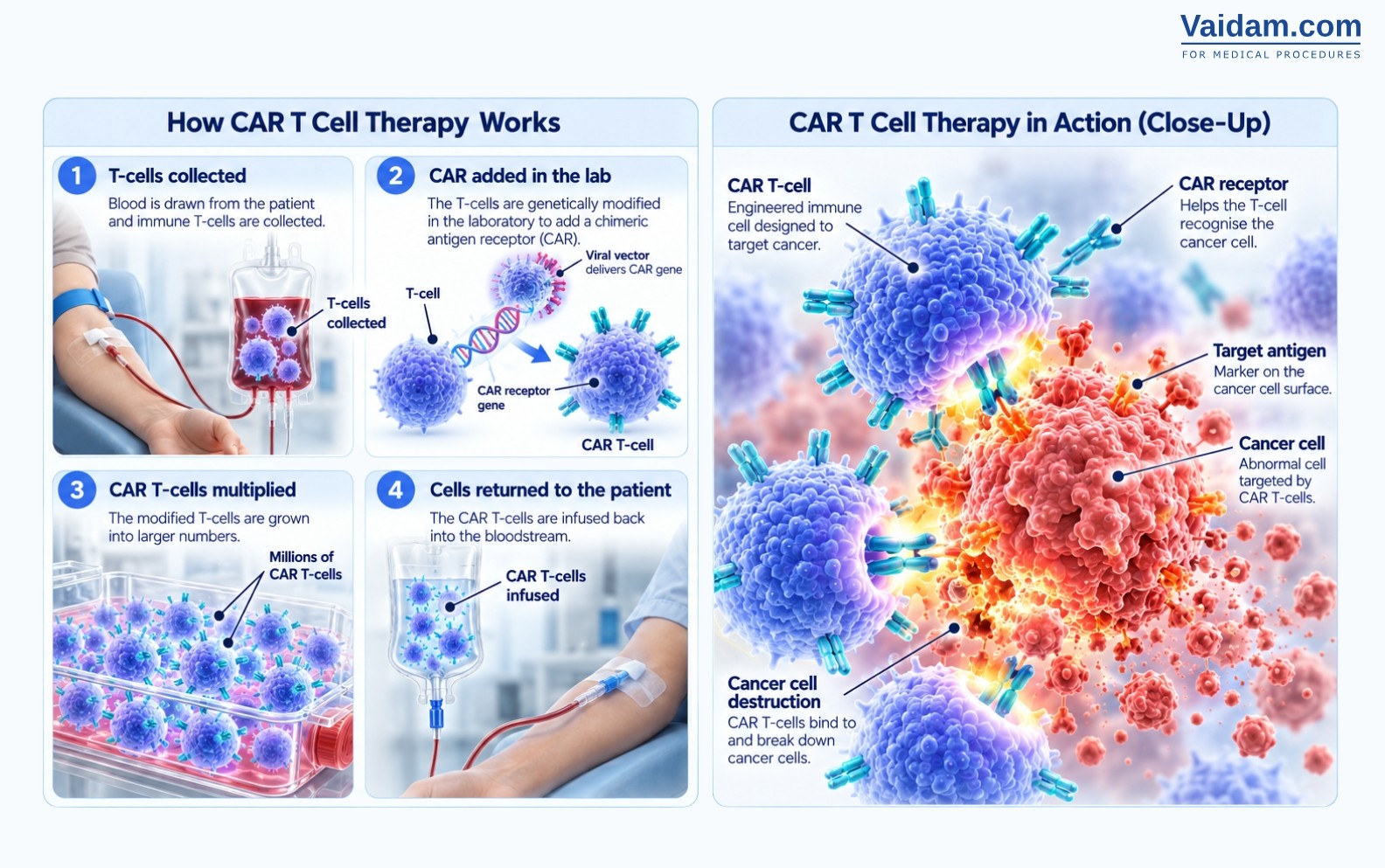
CAR-T vs stem cell transplant. A stem cell transplant replaces the blood-forming system after high-dose chemotherapy. CAR-T does not replace the bone marrow. It redirects your own immune cells against the cancer. Some patients receive both at different points in their treatment.
Approved CAR-T Products in the EU
All products below are approved by the European Commission and available in Germany. Indications are summarised. Each has detailed conditions about previous treatment.
Product (active substance) | Target | Main EU indications |
Kymriah (tisagenlecleucel) | CD19 | B-ALL in patients up to 25 years. Diffuse large B-cell lymphoma (DLBCL) and follicular lymphoma after two or more lines of therapy. |
Yescarta (axicabtagene ciloleucel) | CD19 | Large B-cell lymphoma relapsing within 12 months of, or refractory to, first-line treatment (second line). DLBCL and primary mediastinal B-cell lymphoma (PMBCL) after two or more lines. Follicular lymphoma after three or more lines. |
Tecartus (brexucabtagene autoleucel) | CD19 | Mantle cell lymphoma after two or more lines, including a BTK inhibitor. B-ALL in adults aged 26 and over. |
Breyanzi (lisocabtagene maraleucel) | CD19 | Large B-cell lymphoma, PMBCL and follicular lymphoma grade 3B within 12 months of first-line treatment or after two or more lines. Follicular lymphoma after two or more lines. Mantle cell lymphoma after two or more lines, including a BTK inhibitor (approved November 2025). |
Aucatzyl (obecabtagene autoleucel) | CD19 | B-ALL in adults aged 26 and over (approved July 2025). |
Abecma (idecabtagene vicleucel) | BCMA | Multiple myeloma after at least two prior therapies, including an immunomodulatory drug, a proteasome inhibitor and an anti-CD38 antibody. |
Carvykti (ciltacabtagene autoleucel) | BCMA | Multiple myeloma after at least one prior therapy, including an immunomodulatory drug and a proteasome inhibitor, in patients refractory to lenalidomide (approved April 2024). |
Not yet approved: CAR-T for acute myeloid leukaemia (AML), chronic lymphocytic leukaemia in the EU, and solid tumours such as glioblastoma or pancreatic cancer are available only within clinical trials. Be cautious of offers of "CAR-T for AML" or for solid tumours outside a registered trial.
Who Is Eligible?
The treating team decides based on:
Diagnosis and marker. The cancer must be an approved indication and carry the target marker.
Previous treatment. Each product's approval specifies which treatments must be given beforehand.
Disease control. Rapidly progressing disease may need bridging treatment to control it during manufacturing.
Fitness and organ function. Heart, lung, kidney and liver function, and performance status.
No active uncontrolled infection and, generally, no active central nervous system involvement unless the team judges it manageable.
Enough T cells for collection. Very recent chemotherapy can affect this.
Alternatives your team may discuss include stem cell transplantation, bispecific antibodies (off-the-shelf immunotherapies for lymphoma and myeloma), and clinical trials.
How Is CAR-T Cell Therapy Given in Germany?
Stage | What happens | Typical timing |
1. Evaluation | Review of records, scans (PET-CT), bone marrow test where needed, heart and lung tests, infection screening, tumour board discussion. | About 1 to 2 weeks |
2. T-cell collection (leukapheresis) | Blood is passed through a machine that collects white blood cells. It takes about 3 to 6 hours. | 1 day |
3. Manufacturing | Cells are sent to the manufacturer, modified, multiplied and tested. | About 3 to 5 weeks, depending on the product |
4. Bridging therapy | Chemotherapy, radiotherapy or other treatment if the cancer needs controlling while waiting. | During manufacturing, if needed |
5. Lymphodepleting chemotherapy | Usually fludarabine and cyclophosphamide over about 3 days, to make room for CAR-T cells. | The week before infusion |
6. Infusion | CAR-T cells are infused through a vein, usually in under an hour. | 1 day |
7. Monitoring | Hospital or day-clinic monitoring for side effects, then outpatient checks. | Usually 1 to 2 weeks in hospital, then outpatient follow-up |
8. Staying near the centre | EU product information requires patients to stay near the treatment centre after infusion. This is 2 weeks for Yescarta and Tecartus (since April 2026) and may be 4 weeks for other products. | 2 to 4 weeks after infusion |
Total time in Germany is usually about 2 to 3 months. Occasionally, manufacturing does not produce a product that meets specifications, and the process must be repeated.
Driving. Patients must not drive for several weeks after infusion because of the risk of neurological side effects. For Yescarta and Tecartus, this is at least 4 weeks. Check the rule for your product.
Results of CAR-T Cell Therapy
Cancer and setting | Trial | Result |
Large B-cell lymphoma, second line (relapse within 12 months or refractory) | ZUMA-7 (axicabtagene ciloleucel vs standard care including stem cell transplant), 359 patients | Overall survival at 4 years: 54.6% vs 46.0%. |
Multiple myeloma after 1 to 3 prior lines, lenalidomide-refractory | CARTITUDE-4 (ciltacabtagene autoleucel vs standard regimens) | 74% lower risk of disease progression or death at a median follow-up of 15.9 months. |
Lymphoma, overall experience at one German centre | University Hospital Würzburg, 100 CAR-T infusions by March 2023 | The centre reports a chance of cure in lymphoma of about 30 to 35%. |
How to read these figures:
They come from trials or single centres with selected patients and cannot predict an individual outcome.
Results differ by cancer type, product, previous treatment and how much disease is present at infusion.
Many patients who respond do so within the first 3 months. Relapse can still occur later.
Side Effects and Risks
Side effect | What it is | When it occurs |
Cytokine release syndrome (CRS) | Fever, low blood pressure, low oxygen levels, caused by immune activation. Usually mild; severe cases need intensive care. | Usually within the first days to 2 weeks |
Neurotoxicity (ICANS) | Confusion, difficulty speaking or writing, tremor, drowsiness, rarely seizures or brain swelling. | Usually within the first 1 to 3 weeks |
Low blood counts | Prolonged low white cells, red cells or platelets. | Can last weeks to months |
Infections | Due to low blood counts and low antibody levels. | Weeks to months, sometimes longer |
Low antibody levels | B cells are also destroyed by CD19 products. Immunoglobulin replacement may be needed. | Months to years |
Delayed neurological effects | With BCMA products, rare movement and nerve problems (such as parkinsonism) have been reported. | Weeks to months |
Secondary cancers | The EMA concluded in 2024 that T-cell cancers can occur after CAR-T. About 38 suspected cases were reported among about 42,500 treated patients, roughly 1 per 1,000. | Most within 12 months |
Because of the risk of secondary cancers, EU product information recommends lifelong monitoring after CAR-T therapy.
Centres treat CRS and ICANS with medicines such as tocilizumab and corticosteroids, and have intensive care available at all times.
What Treatment in Germany Involves for International Patients?
Quality signals
G-BA quality directive. Since 2020, German hospitals must meet binding requirements from the Federal Joint Committee (G-BA) to give CAR-T therapy to patients with statutory insurance. These cover specialist haematology staff, nursing expertise, experience with cell therapies, intensive care and management of complications. The directive is part of the ATMP Quality Assurance Guideline (ATMP-QS-RL).
Number of centres. In 2022, the German Medical Journal (Deutsches Ärzteblatt) reported 31 qualified centres for CD19-directed CAR-T and 9 for myeloma. The number has since grown.
Stem cell transplant programme. Experienced CAR-T centres usually also have an established stem cell transplant unit.
Clinical trials and in-house research. A few centres manufacture CAR-T cells for academic studies and run trials of new products.
Costs are paid in advance.
German hospitals require payment of an advance invoice before the CAR-T product is ordered. The product is made individually for each patient, so it cannot be used for anyone else.
Hospitals for CAR-T Cell Therapy in Germany
Check whether a hospital:
meets the G-BA quality requirements for CAR-T therapy
is qualified for the specific product and indication you need
has treated many patients with CAR-T and with your type of cancer
has an established stem cell transplant unit and intensive care
offers clinical trials
has an international patient office that provides written estimates and interpreters
The hospitals below are examples with verified information. This is not a ranking or endorsement.
Hospital | City | Verified information |
Heidelberg University Hospital, Department of Medicine V | Heidelberg | One of the first centres in Germany to use CAR-T therapy for leukaemia. Its leukapheresis team performs more than 1,000 collections a year. It has a certified GMP laboratory that makes CAR-T cells in-house for clinical studies, which only a few German clinics can do. |
University Hospital Würzburg, Department of Medicine II | Würzburg | CAR-T programme since 2016. Gave its 100th CAR-T infusion in March 2023. Treats aggressive and low-grade lymphoma, ALL and multiple myeloma. The hospital reports that about 2% of its CAR-T patients needed intensive care. |
Many other German university hospitals offer CAR-T therapy, including those in Frankfurt, Freiburg and Ulm. Certifications, specialists and international services change. Vaidam can confirm current details for the hospitals you are considering.
Cost of CAR-T Cell Therapy in Germany
No single fixed price applies. The total cost includes the CAR-T product, evaluation, leukapheresis, bridging and lymphodepleting chemotherapy, the hospital stay, any intensive care, and follow-up.
What affects the total cost?
Cost component | Why it varies |
CAR-T product | Product and indication |
Evaluation | PET-CT, bone marrow tests, heart and lung tests |
Bridging therapy | Whether needed, and what type |
Hospital stay | Days in hospital after infusion |
Intensive care | Needed for severe CRS or ICANS in some patients |
Supportive care | Transfusions, antibiotics, immunoglobulin replacement |
Non-medical costs | Accommodation for 2 to 3 months for patient and caregiver, interpreters, travel, visa |
How International Patients Can Prepare?
Medical documents to gather
Pathology reports confirming the diagnosis, and biopsy blocks or slides if requested.
Marker test results, such as CD19 or BCMA, and molecular and genetic results.
Recent PET-CT or CT scans (on disc or download link), with reports.
Bone marrow reports, for leukaemia and myeloma.
Complete treatment history, including every drug, cycle, radiotherapy, and transplant, with dates and response. This determines which product you qualify for.
Current blood tests, heart tests (echocardiogram, ECG) and infection screening results.
Reports in languages other than English or German may need translation.
Travel and administrative documents
Visa. Most non-EU patients need a visa for medical treatment. Applications usually need the hospital's invitation letter with a cost estimate, proof of funds and health insurance. Allow for a stay of 2 to 3 months.
Caregiver. A caregiver must stay with you after infusion, as neurological side effects can occur suddenly.
Other items to arrange:
proof of funds or an insurer's guarantee of payment
accommodation close to the hospital, within the distance required by the product information
a plan for long-term follow-up at home
Questions to Ask Your CAR-T Team
Am I eligible for CAR-T, and which product applies to my cancer and treatment history?
Are bispecific antibodies, a stem cell transplant or a clinical trial reasonable alternatives?
Will I need bridging therapy while my cells are manufactured?
How many patients with my cancer has your centre treated with CAR-T?
What are your rates of severe CRS, ICANS and intensive care admission?
How long must I stay near the hospital after infusion?
What happens if manufacturing fails?
What does the cost estimate include and exclude, especially intensive care?
How will long-term follow-up be arranged with my doctors at home?
Recovery and Follow-Up
First 2 to 4 weeks. Check daily or frequently for fever, confusion, or other symptoms. Your caregiver should know the warning signs and carry the patient alert card.
Weeks 4 to 12. Frequent outpatient visits. Blood counts recover gradually. Avoid infections.
First response assessment. Usually a PET-CT or bone marrow test about 1 to 3 months after infusion.
Long term. Regular blood tests, including antibody levels, and vaccinations restarted according to the team's plan. Lifelong monitoring is recommended, including for secondary cancers.
Follow-up is usually shared between the German centre and your haematologist at home.
How Vaidam Helps International Patients?
Vaidam Health is a medical travel facilitation service. It does not provide medical treatment itself. When you contact Vaidam, you are assigned a case manager who can:
share your records and scans with German CAR-T centres for an eligibility opinion and treatment plan
obtain a medical opinion and written cost estimate, usually within 48 hours
help you compare hospitals against the criteria above
help with visa documentation and the hospital's invitation letter
arrange accommodation near the hospital for you and your caregiver, airport transfers and appointment scheduling
arrange interpreters (in Germany, interpreter services are chargeable)
stay in contact after you return home to help with follow-up consultations and reports
Vaidam states that its services are free for patients and do not increase the hospital bill. Treatment decisions remain with your doctors.
Frequently Asked Questions
1. How much does CAR-T cell therapy cost in Germany?
German statutory insurers pay about €275,000 to €285,000 for the CAR-T product alone. Estimated self-pay prices at German university hospitals are about €537,000 to €621,000, including hospital care. The hospital's written estimate sets the actual price.
2. Which cancers can be treated with CAR-T in Germany?
Approved indications include certain B-cell lymphomas (large B-cell, follicular, mantle cell and primary mediastinal), B-cell acute lymphoblastic leukaemia and multiple myeloma. CAR-T for AML and solid tumours is available only in clinical trials.
3. Is CAR-T only for patients who have run out of options?
No. For large B-cell lymphoma that relapses within a year of first treatment, and for some lenalidomide-refractory myeloma after one prior line, CAR-T is approved in the EU as an earlier option.
4. How long will I need to stay in Germany?
Usually about 2 to 3 months. This covers evaluation, T-cell collection, 3 to 5 weeks of manufacturing, the infusion and the required period near the centre afterwards.
5. What are the main side effects?
Cytokine release syndrome (fever and low blood pressure) and neurotoxicity (confusion, speech problems) are the main early risks. Low blood counts and infections can last longer. Secondary T-cell cancers are rare, about 1 per 1,000 patients.
6. Do I need a caregiver?
Yes. A caregiver must stay with you for the first weeks after infusion, as neurological side effects can appear suddenly.
7. How do I choose a CAR-T centre in Germany?
Look for a centre that meets the G-BA quality requirements, is qualified for your product and indication, has treated many patients with your cancer, has a stem cell transplant unit and intensive care, and offers trials.
8. How successful is CAR-T therapy?
It depends on the cancer and setting. In the ZUMA-7 trial for early relapsed large B-cell lymphoma, 54.6% of patients treated with CAR-T were alive at 4 years, compared with 46.0% with standard care. Individual outcomes vary.
9. What happens if my cells cannot be manufactured?
Occasionally the product does not meet specifications. The team may repeat T-cell collection or discuss other treatment. Ask how the centre and manufacturer handle this, including the cost.
10. Is CAR-T covered by German health insurance?
German statutory and private insurance covers CAR-T for residents at qualified centres. International patients usually pay themselves unless their insurer agrees in advance to cover treatment abroad.
Sources
Deutsches Ärzteblatt: CAR-T-Zell-Therapie, in der Versorgung angekommen (3 February 2022, updated April 2024; number of centres and Yescarta and Kymriah prices).
Ärzte Zeitung: Erstattungsbetrag für Kymriah vereinbart (October 2019).
Ecker + Ecker: ATMPs in Germany, Carvykti (launch price and agreed price).
G-BA press release: best possible safety in cancer therapy with CAR-T cells (17 September 2020). G-BA ATMP Quality Assurance Guideline (ATMP-QS-RL).
EMA: secondary malignancy of T-cell origin after CAR T-cell therapy, conclusions from 38 suspected cases (Gene Therapy, 2025). EMA DHPC, June 2024.
Kite: EMA approves updated safety information for Yescarta and Tecartus (24 April 2026).
Bristol Myers Squibb: European Commission approval of Breyanzi for mantle cell lymphoma (24 November 2025).
Autolus: European marketing authorisation for Aucatzyl in adult B-ALL (21 July 2025).
OncLive: European Commission approves cilta-cel after at least one prior line (22 April 2024).
ASCO Post: overall survival with axicabtagene ciloleucel in large B-cell lymphoma, ZUMA-7 (July 2023).
Heidelberg University Hospital: CAR-T-Zelltherapie, Department of Medicine V.
University Hospital Würzburg: 100th patient receives CAR-T cell therapy (8 March 2023).
Vaidam.com homepage (service descriptions).



 Chat
Chat